This week brought Google’s Gemini 4 Argon (October 13) and Meta’s Muse Wonder (October 12), arriving beside Claude Opus 5.5 and OpenAI’s GPT-6 Astra. I haven’t run any of them. This is a compilation of published numbers from my other posts, with their sources, so you can see what’s comparable. Details and links are in the Argon post and the Muse Wonder post.
Price per million tokens (input / output)
| Model | Price | Notes |
|---|---|---|
| Gemini 4 Argon | $2 / $10 | Introductory; doubles to $4 / $20 after Nov 30 |
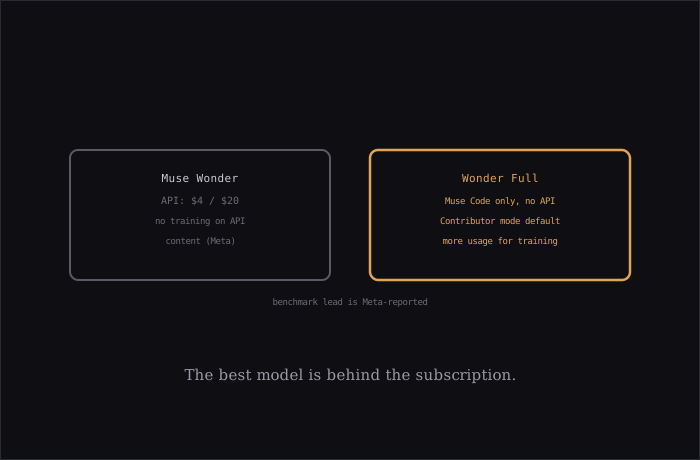
| Meta Muse Wonder | $4 / $20 | API only; Wonder Full has no API |
| Claude Opus 5.5 | $4 / $20 | Matched by Wonder, per Let’s Data Science |
| GPT-6 Astra | not confirmed | OpenAI says GPT-6.1 Sol is about one-fifth of Astra’s price |
I could not confirm Astra’s list price from the sources I read, so I left it out instead of guessing.
Independent score: Artificial Analysis Intelligence Index
- Claude Opus 5.5: 58
- Muse Wonder Full: 56 (not available by API)
- GPT-6 Astra: 53
- Gemini 4 Argon: 53
- Muse Wonder: 52
Artificial Analysis also estimates an average index task costs about $4.52 on Wonder, $5.98 on Opus 5.5 and $3.26 on Astra.
Coding and agent tests (mixed sources)
- Terminal-Bench 4.0 (Google’s table): Argon 57.4% vs Opus 5.5 66.4%. Artificial Analysis’s own Terminal Bench 4 has Argon at 57%, behind Sonnet 5.5 and Opus 5.5.
- DeepSWE v1.1 (Google’s table): Argon 77.9%. In my Mistral Large 4 post, Mistral’s model scored 61.7% on DeepSWE against about 74% for leaders, which suggests how crowded the top is. Different tables, so don’t subtract.
- SWE-Marathon (Meta’s own test): Wonder Full 57.5, Opus 5.5 46.3, Astra 42.5.
- Small hands-on test: in one writer’s three-task DevOps trial, Opus 5.5 and GPT-6.1 Sol deployed Kubernetes manifests correctly all three times; Argon needed the error fed back. A tiny sample.
Why none of this settles it
- Vendors choose the tests. Google’s and Meta’s tables each lead in the tests they published. Opus 5.5 still leads on several third-party measures.
- Different setups. Google says it used single attempts at the highest thinking settings, and competitor scores mostly come from provider reports or leaderboards, not one lab.
- Access differs. Wonder Full can’t be called from your own agent, and Argon is paid-API only with Antigravity gated by plan.
- Cost isn’t just the sticker price. Wonder Full reportedly used 140M output tokens against a median of 88M, so a token-hungry model can cost more than its rate card suggests.
- Data policy differs. Muse Code defaults to Contributor mode, which allows training on your content. See the Muse Wonder post.
How I’d choose
I’d run my own repository’s tasks through two or three candidates, with the same prompt, the same permissions and a test suite as the judge, and compare cost per accepted change, not benchmark rank. The cheap Haiku 5.5 and Mellum 2.1 posts cover the low-cost end for routing and sub-agents.
If you want one sentence: Opus 5.5 still has the strongest independent numbers in what I found, Argon has the best intro price and long-context claims, and Meta’s best model isn’t something you can integrate yet.
Sources: Google’s Argon coverage via Computing for Geeks, Online Tech Tips, Let’s Data Science, TechCrunch.