Meta released Muse Wonder and Muse Wonder Full on October 12 from its Superintelligence Lab, calling them its first frontier-class models. I’m working from TechCrunch’s launch coverage and a Let’s Data Science write-up that cites Meta’s help center and VentureBeat. I haven’t used either model. Most claims below are Meta’s own.
What you can actually get
- Muse Wonder is available through the Meta Model API (
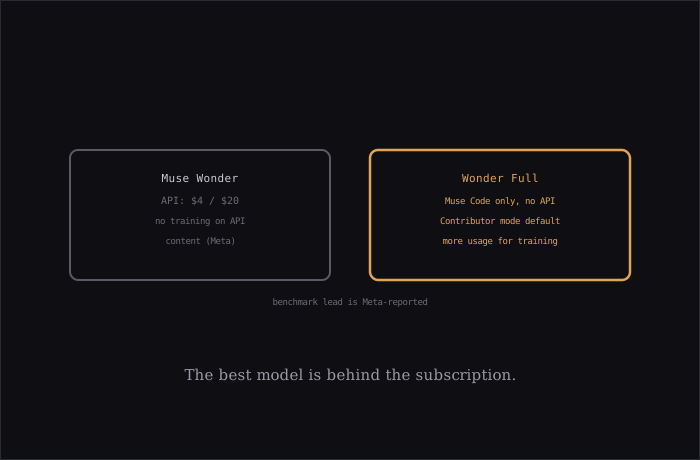
muse-wonder-1.0) and in Muse Code. API pricing is $4 per million input tokens, $20 per million output tokens, with cached input at $0.20. - Muse Wonder Full is available only inside Muse Code subscriptions. There is no API endpoint, and Artificial Analysis reportedly lists it as having no publicly available API.
- Neither has downloadable weights. Both reportedly have a context window of about 1 million tokens, per VentureBeat.
- Muse Code plans are reported at $5, $15, $50 and $200 a month. VentureBeat says the $50 and $200 tiers are the way to reach Wonder Full, though Meta’s own wording says only that those plans include “the most powerful Muse models.”
The default that matters most
Muse Code subscriptions default to Contributor mode. Per Meta’s documentation, it gives more usage “in exchange for letting Meta use your content to train future Meta models.” You can switch it off at any time, but Meta says content already submitted isn’t covered by the opt-out. VentureBeat reports that Meta’s terms bar sending confidential, sensitive or personal information while it’s on, and zero-data-retention accounts can’t use it.
On the API, Contributor mode isn’t available for Muse Wonder, and Standard-mode content isn’t used for training, according to Meta’s pricing page. So the training question applies to the coding subscription, not the API.
If you’d point a coding agent at an employer’s repository, check that setting first. The Let’s Data Science writer calls the default a “compliance problem” for employer code, which is their view, but it’s a reasonable one.
The benchmark picture (mixed sources)
The numbers come from a table that mixes Meta’s results and third-party ones, so treat it as provisional.
- Artificial Analysis Intelligence Index: Wonder Full 56, Wonder 52, GPT-6 Astra 53, Claude Opus 5.5 58.
- SWE-Marathon (Meta’s own test): Wonder Full 57.5, Opus 5.5 46.3, Astra 42.5.
- Opus 5.5 still leads on the overall index, Terminal-Bench, JobBench and HealthBench Pro.
- Cost per index task (Artificial Analysis estimate): about $4.52 on Wonder, $5.98 on Opus 5.5 and $3.26 on Astra. Wonder Full reportedly used 140M output tokens against a median of 88M.
Meta’s headline feature is “active memory,” and TechCrunch says Meta claims Wonder beats several rivals on MemoryBench. The full safety report is “available soon.”
What I’d do
Don’t switch on the headline. The lead on Meta’s own coding test is exactly the kind of result that needs outside runs, and the best model isn’t reachable by API, so you can’t wire it into your own agent or compare it fairly. If you try Muse Code, decide on Contributor mode deliberately. For an at-a-glance comparison with this week’s other launches, see my model comparison post.
Sources: TechCrunch, Let’s Data Science.


