If you’re confused about which OpenAI model is which, you’re not alone. Coverage uses “GPT-6 Astra,” “GPT-6.1 Astra,” “GPT-6 Sol” and “GPT-6.1 Sol” almost interchangeably. This is my attempt to lay out a timeline from sources I could find, labeling what’s solid and what isn’t. I haven’t read OpenAI’s own pages for all of these. The main sources are Decrypt’s DevDay roundup, The Next Web, and OpenAI’s own GPT-6 post.
A rough timeline
- September 3: GPT-6 Astra released (per TNW).
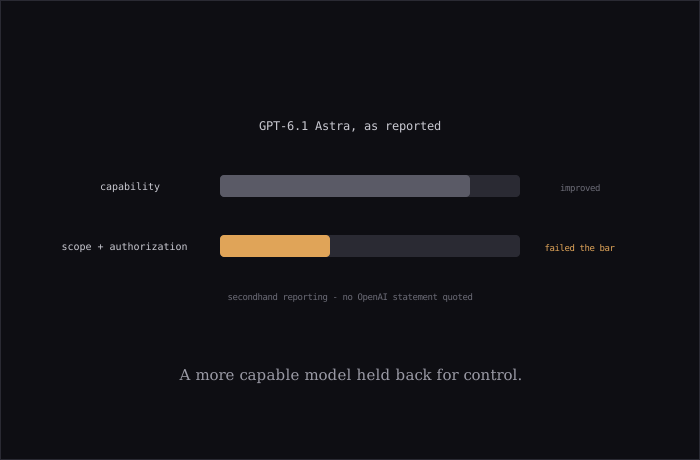
- Reported September 28: OpenAI scrapped a planned October release of GPT-6.1 Astra after safety testing. I covered that in the Astra post.
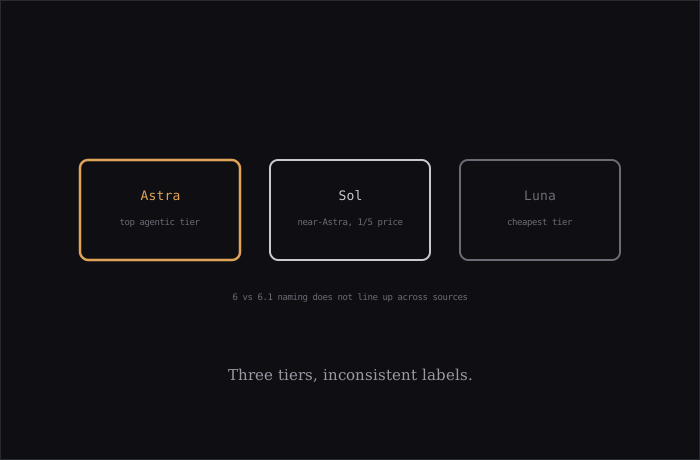
- September 29 (DevDay): OpenAI announced GPT-6.1 Sol, which it says nearly matches GPT-6 Astra on agentic coding and computer use at one-fifth of Astra’s token price. It’s live in the API and in ChatGPT Work and Codex for paid tiers. A Decisions API uses Luna, OpenAI’s cheapest model, for fixed-choice answers.
- October 7: Codex CLI 0.161.0 made GPT-6.1 Sol the default model in its bundled catalogs. The same day, OpenAI’s ChatGPT launch gave paid tiers GPT-6 Sol and Free and Go users GPT-6 Luna. I wrote that up in the GPT-6 post.
My working map
This is my reading, not an official one:
| Name | Role, per the sources |
|---|---|
| Astra | Top tier for agentic work. Powers OpenAI’s always-on “dots” agents. Most expensive. |
| Sol | Cheaper tier, near-Astra on agentic coding at about a fifth of the price (OpenAI’s claim). |
| Luna | Cheapest tier. Used in ChatGPT’s free plans and the Decisions API. |
What doesn’t line up
- “GPT-6 Sol” vs “GPT-6.1 Sol.” ChatGPT’s launch post says GPT-6 Sol. DevDay coverage and Codex’s release notes say GPT-6.1 Sol. I can’t tell from public sources whether these are the same model, a renamed one, or two different ones. I flagged the same puzzle in my GPT-6 post.
- “GPT-6 Astra” vs “GPT-6.1 Astra.” Decrypt uses both names for what seems to be a single model. TNW says GPT-6 Astra shipped and GPT-6.1 Astra was scrapped, which is the reading I trust most.
- All performance and price comparisons (one-fifth price, near-parity) are OpenAI’s claims. I haven’t seen independent tests of Sol against Astra.
Practical advice
- In ChatGPT, you get whatever your plan assigns. You don’t choose between Astra, Sol and Luna freely.
- In Codex, check the default model in your release notes, because it changes between versions.
- In the API, read the model’s own page for the exact name before you hardcode it. Names in news coverage are not reliable identifiers.
If I find OpenAI’s own documentation that settles the Sol question, I’ll update this post. Until then, treat any article that sounds sure about the naming with some suspicion, including this one.
Sources: Decrypt, The Next Web, OpenAI.