Dating note: OpenAI’s DevDay was September 29, so this is a catch-up. The coverage was dominated by the “dots” agent product, which I cover in a separate post. This one is about the pieces a developer can build with. The source is Decrypt’s DevDay roundup. I haven’t tried any of these, and the performance and pricing claims are OpenAI’s.
For people building agents
- Agents API: adds computer use, multi-agent tools, tool search and context compaction. It’s available through the API and in Codex and ChatGPT Work for Pro 500 and Enterprise customers.
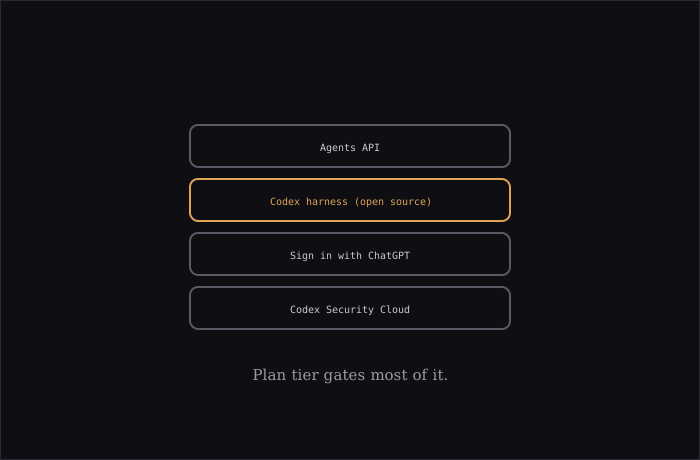
- Codex harness: OpenAI says the harness now powers dots and is open source. This is the part I’d look at first, since it’s the agent loop itself. The roundup doesn’t link a repository, and I haven’t verified the license or contents, so check OpenAI’s own repository before assuming anything.
- Decisions API: uses Luna, OpenAI’s cheapest model, for fixed-choice answers. Limited preview, with broad release “in the coming days.”
- Bedrock Managed Agents: run OpenAI agents inside AWS. Not available to Plus or free users.
For security and privacy
- Codex Security Cloud: scans GitHub repositories on demand or on a schedule, checks new commits and prepares fixes in the cloud. Available to Pro, Business, Enterprise and Edu.
- Private Intelligence: zero data retention plus automated safety checks. A Private Inference preview using confidential computing is due this fall.
For distribution
- Sign in with ChatGPT: lets users spend their ChatGPT plan allowance in partner tools. OpenAI lists 16 partners, including Devin, Notion and Vercel. For a small developer, “your user’s subscription pays for inference” is the interesting idea.
- Plugin extensions: third-party apps inside ChatGPT on all plans. OpenAI cites 1.2 billion weekly users, which is its number.
- OpenAI Marketplace: lets eligible enterprise customers apply existing OpenAI commitments to 32 partner products.
Speed and price
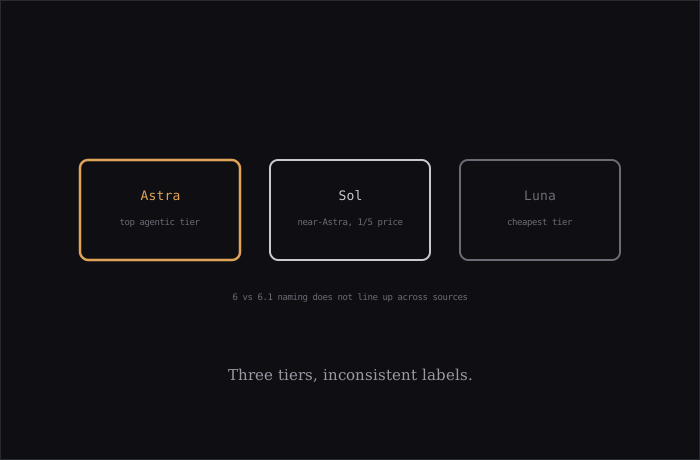
- GPT-6.1 Sol nearly matches GPT-6 Astra on agentic coding and computer use at one-fifth of Astra’s token price, per OpenAI. See my model-names post for how Astra, Sol and Luna relate.
- Ultrafast: a premium speed tier, claimed up to 8x faster in Codex and 6x in the API. Astra Ultrafast is live on Pro 500 and Enterprise, with a Sol version coming, and it’s bundled with the $500-a-month Pro 500 plan. Decrypt notes the live demo failed several times on stage, which doesn’t prove anything about the product, but I’d want independent timing before paying for it.
Caveats
- Naming is inconsistent. The roundup calls the pulled model both “GPT-6.1 Astra” and “GPT-6 Astra,” and also includes an Anthropic comparison on data retention with no source in the text, which I’m ignoring.
- Plans matter. Several features are limited to Pro, Pro 500, Business or Enterprise. Plus and Free are often excluded. Check your plan before planning around any of this.
What I’d try first
If I were building on this, I’d read the open-source Codex harness before the marketing, because a readable agent loop teaches more than a launch video. After that, I’d test Sign in with ChatGPT on a small side project to see how the allowance model feels. Everything else depends on plan tier and price, and those claims need outside verification.
Source: Decrypt.