JetBrains, the company behind IntelliJ and PyCharm, released Mellum 2.1 on Hugging Face this week. Everything below comes from the model card, which means it is JetBrains’ own description, and the benchmark numbers are JetBrains’ own too. The card gives no explicit release date.
What it is
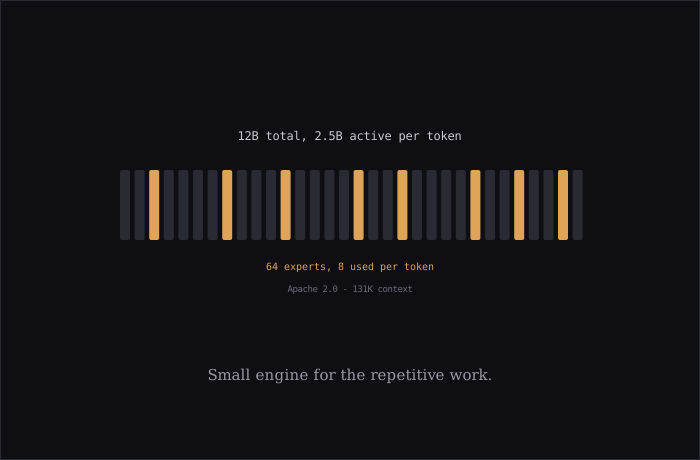
- 12B parameters total, about 2.5B active per token. It’s a mixture-of-experts model with 64 experts, 8 used per token, across 28 layers.
- 131,072-token context window.
- Apache 2.0 license.
- It’s a fine-tune of JetBrains’ Mellum2 base model, with most of the new work in reinforcement-learning post-training.
- The card calls it a “Thinking” model for complex agentic tasks like working in a repository, running commands and calling tools, and for harder coding, math and reasoning problems.
Because only about 2.5B parameters are active per token, it should compute faster than a dense 12B model, though you still need memory for all 12B. JetBrains’ stated pitch, repeated in a tech-news write-up, is a fast, self-hostable backbone for routing, Q&A and sub-agents, not a top-end reasoning model.
The benchmarks, self-reported
| Test | Mellum 2.1 | Qwen3.5 (9B) |
|---|---|---|
| LiveCodeBench v6 | 82.0 | 75.4 |
| SWE-bench Verified | 47.0 | 50.0 |
| AIME 25/26 | 83.3 | 86.7 |
| GPQA Diamond | 64.6 | 77.8 |
So it leads on LiveCodeBench but trails on SWE-bench Verified, the one closest to real repository work, as well as on math and science questions. JetBrains ran every evaluation with its own pipeline, so I’d treat this as a rough sketch and not a ranking.
Running it
The model card shows a vLLM command:
vllm serve JetBrains/Mellum2.1-12B-A2.5B-Thinking --max-model-len 131072 --reasoning-parser qwen3
Add --enable-auto-tool-choice --tool-call-parser hermes for tool calling. Transformers, SGLang and Docker Model Runner are also listed. The card says GGUF builds for llama.cpp, Ollama and LM Studio are “coming soon,” although the model tree already lists quantized variants, so check what’s actually available before you plan a laptop setup.
Why I’m interested
Most open-model news is about giant models. This is the opposite: a small, permissively licensed one meant to sit under an agent and do the high-volume work. It pairs naturally with the cost story in my Claude Haiku 5.5 post, just on the self-hosted side. I’d wait for independent SWE-bench runs before moving anything important to it.
Sources: Hugging Face model card, Tech Insider.