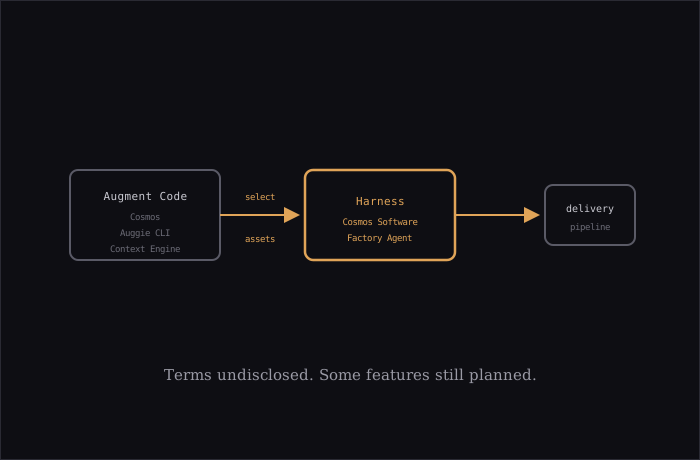
Coding-agent companies are starting to get absorbed by bigger platforms. On October 8, Harness, the software-delivery company, announced it was acquiring select assets from Augment Code. This summary is based on Harness’s own announcement, so it describes what the buyer says, in the buyer’s words.
What was bought
- Cosmos, Augment’s agent platform, now renamed the Harness Cosmos Software Factory Agent
- The Auggie CLI
- The Code Context Engine
- “Related technology,” and the Augment team joins Harness
Financial terms weren’t disclosed. The post names only those three products as acquired and says nothing about the future of any other Augment Code products.
What Cosmos does, per Harness
Harness describes taking engineering work from idea to code, with its other agents handling delivery to production.
- Work can start from events: ticket updates, pull requests, schedules and webhooks.
- Agents can plan changes, write code and tests, open pull requests, and respond to review comments, failed checks and merge conflicts.
- There are prebuilt “Experts” (PR Author, Deep Reviewer, Risk Analyzer, Verifier) that teams can customize.
- The included infrastructure covers execution environments, model routing, the Code Context Engine, tool integrations, shared memory and budget controls.
- Teams choose which actions agents can take alone and where a human must approve.
Customers can use Cosmos, keep their preferred coding tools, or use both.
Available now versus not yet
Cosmos is available now, according to the post, with a ticket-to-pull-request demo video. Three things are described as planned, not shipped:
- Connecting the Code Context Engine to Harness’s Software Delivery Knowledge Graph
- A loop that sends downstream findings (security, testing, deployment) back into code fixes
- Tying Cosmos workflows to Harness’s policy, access, approval and audit controls
A separate news summary of The New Stack’s coverage also says a feature that learns from failed deployments isn’t released yet, which fits the “planned” list above.
What I’d watch
If you or your team use Augment’s tools, the unanswered question is what happens to the rest of the product line, and to Auggie CLI specifically, now that it belongs to a delivery-platform company. The announcement doesn’t say.
The bigger pattern is that an agent which writes code is easy to demo, while one that fits into approvals, audit trails and deployment is the hard part, and that is where Harness is placing its bet. I wrote about a similar reach into the whole developer workflow in the GitHub Copilot overview.
Source: Harness.