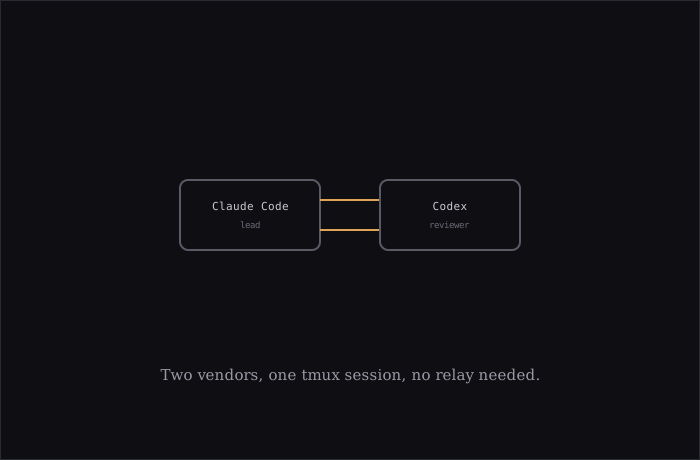
OpenRig has been climbing GitHub’s trending list for three days straight now, and the specific thing it’s built around is worth explaining properly: not another multi-agent framework coordinating several instances of the same model, but Claude Code and Codex — two different vendors’ actual coding agents — running together in one managed system, communicating with each other directly.
The core distinction, in the project’s own framing: a harness wraps a model. A rig wraps your harnesses. OpenRig is a local daemon, CLI, MCP server, and React UI, all built on top of tmux, that lets you describe a team of agents in a declarative YAML format — RigSpec — boot the whole team with one command, and watch a live topology of who’s talking to whom. The included starter, called “conveyor,” sketches the shape directly: a four-seat team mixing Claude Code and Codex into roles named lead, planner, builder, and reviewer, with agents messaging each other and queuing work directly over tmux rather than a human manually relaying what one agent said to the other.
Why running two different vendors’ agents together is actually a meaningfully different idea than running several copies of one: everything I’ve covered under multi-agent orchestration so far has generally assumed a shared underlying harness coordinating instances that speak the same internal language. Mixing Claude Code and Codex specifically means coordinating two agents built by different companies, with different tool-calling conventions and different session models, as genuine peers rather than interchangeable workers. OpenRig’s own creator frames the practical case directly: a peer agent that monitors and absorbs the lead’s mental model in real time can take over if the lead’s context limit gets hit, or if something else goes wrong — a specific, concrete answer to a failure mode anyone who’s run a single long agent session has hit personally.
The part worth knowing if you’re already using Anthropic’s own managed infrastructure: OpenRig’s own documentation draws the comparison directly against Claude Managed Agents, Anthropic’s cloud-hosted, Claude-only runtime billed at $0.08 per session-hour. OpenRig positions itself explicitly as the local alternative — open source, cross-vendor, running entirely on your own machine, with no per-hour cost — in exchange for owning the actual machine-prep and session management yourself rather than handing it to a managed service.
What it’s actually built from underneath: existing Claude Code and Codex sessions in tmux can be discovered and adopted directly into a managed rig rather than requiring a fresh start, teams and individual agents save as plain YAML files that can be snapshotted and restored by name later, and a Pi adapter lets Pi itself join a rig as a terminal-pane RPC runner alongside the two primary harnesses — meaning the cross-harness ambition genuinely extends past just the two vendors in its own tagline.
The honest scope check, the same one I’d apply to any orchestration layer: this is infrastructure for when you’ve already decided you want more than one agent working a problem together, not something that makes a single session better on its own. If what you’re running today is one capable agent handling one task at a time, OpenRig adds real complexity for no corresponding benefit. Where it’s actually aimed is the specific, narrower situation where you already want a lead-and-specialist team, you want that team to survive a context limit without losing the thread, and you’d rather own that infrastructure locally than pay a managed service by the hour for it.