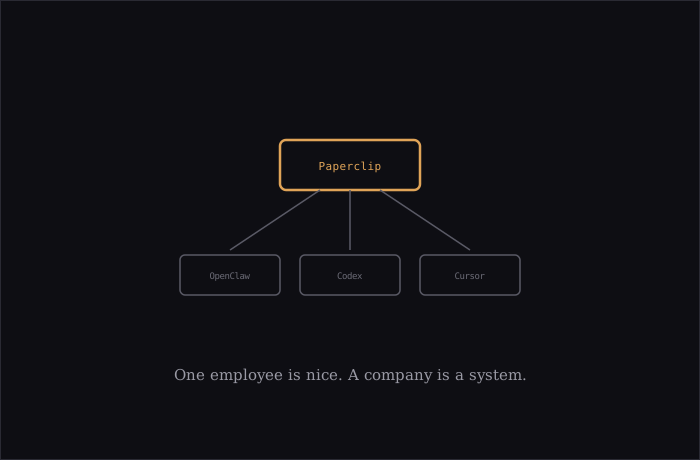
Paperclip’s own tagline does more explaining than most of what I could write myself: if OpenClaw is an employee, Paperclip is the company. I covered OpenClaw last week as a single, self-hosted assistant reachable through your messaging apps. Paperclip is the layer above that — not one agent, but the management structure for a whole team of them.
What it actually is: a Node.js server and React UI, MIT licensed, that orchestrates multiple AI agents against real business goals rather than one-off tasks. You define a mission, hire agents from whatever’s already running — OpenClaw, Claude Code, Codex, Cursor, a plain bash script, or any HTTP-reachable agent — and Paperclip handles the coordination: org charts and reporting lines, cost budgets with automatic throttling when an agent runs over, audit trails, and approval gates before anything ships. The framing on its own repo is blunt about the problem it’s solving: “if it can receive a heartbeat, it’s hired.”
The specific pain points it’s built against, in its own words: a runaway agent loop burning hundreds of dollars in tokens before anyone notices; recurring jobs — support tickets, reports, social posts — that need a human to remember to manually kick off each time; an idea that dies because starting it means finding the right repo, opening a terminal, and babysitting a session instead of just declaring what needs doing. Paperclip’s answer to each is a specific mechanism: budget enforcement that’s atomic, so two agents can’t double-spend the same allowance; heartbeats, which handle scheduled recurring work without a human remembering to trigger it; and a task-based interface where you add work to a queue and an agent claims and finishes it while you do something else.
The technical shape underneath: an embedded PostgreSQL database for local use with zero setup, or point it at your own Postgres for a real deployment; a family of sandboxed Agent Runtime images specifically for executing agents like Claude Code, Codex, and Gemini safely; and a plugin/adapter system so self-hosted installs can add support for new agent runtimes without needing changes to Paperclip’s own core. It genuinely runs multiple separate “companies” from one instance if you want that.
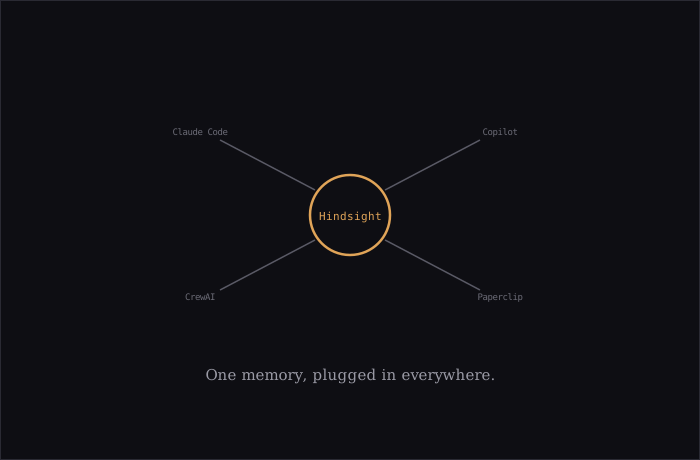
Where this connects to something I wrote about very recently: Hindsight, the persistent-memory project I’m also covering today, ships a dedicated Paperclip integration — install one plugin, and every agent hired into your Paperclip company automatically gets memory that survives across runs, companies, and restarts. That’s a genuinely clean illustration of how this ecosystem is actually composing right now: OpenClaw gives you one capable agent reachable anywhere, Paperclip gives that agent — and a whole team of others — an organizational structure and a budget, and a memory layer like Hindsight plugs into the seams between them rather than each project reinventing its own.
The honest scope check: this is infrastructure for running several agents against real, ongoing goals with actual money and actual approvals at stake — not something you need for a single quick coding session. If OpenClaw already covers what you’re doing, you don’t need Paperclip on top of it. It’s built for the specific point where “one agent helping me” turns into “several agents I need to actually manage.”