Dating note: Anthropic released Claude Haiku 5.5 on Wednesday, October 7, and I’m writing this a day later. The reason it’s worth a post is simple. Small models are what coding agents use for the boring, high-volume parts, and this one got a lot cheaper.
The price
According to Resultsense’s report:
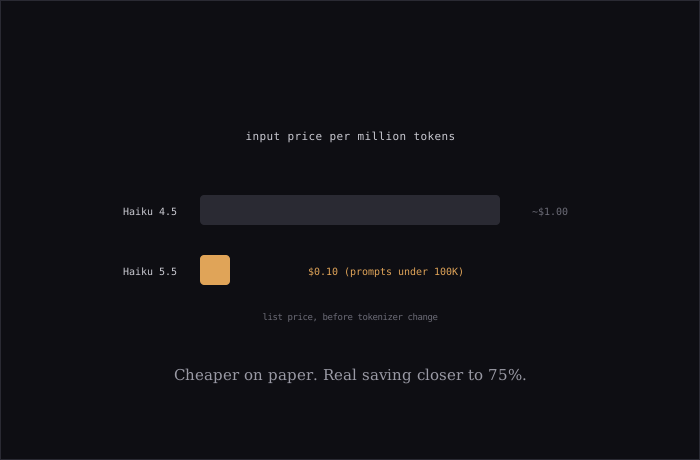
- Prompts under 100,000 tokens: $0.10 per million input and $0.50 per million output. That’s a 90% cut from Haiku 4.5.
- Prompts over 100,000 tokens: $0.50 input and $2.50 output, half the old rate.
- A new tokenizer uses slightly more tokens for the same text, so the average real saving is closer to 75%.
A rough sense of scale, using the headline rate: a sub-agent that reads 50,000 tokens of input for each of 100 tasks processes 5 million input tokens, which is about $0.50 before output costs. The same article says Sonnet 5.5 cache reads were halved too, from $0.20 to $0.10 per million.
What’s new in the model
- It’s the first Haiku with an adjustable effort level, so you can trade cost against capability per request.
- Anthropic points it at summaries, context compaction, database queries, classification, and sub-agent work underneath larger coding models.
- It’s available on Anthropic’s platform, Microsoft Azure, AWS and Google Cloud.
The benchmarks, with the caveat
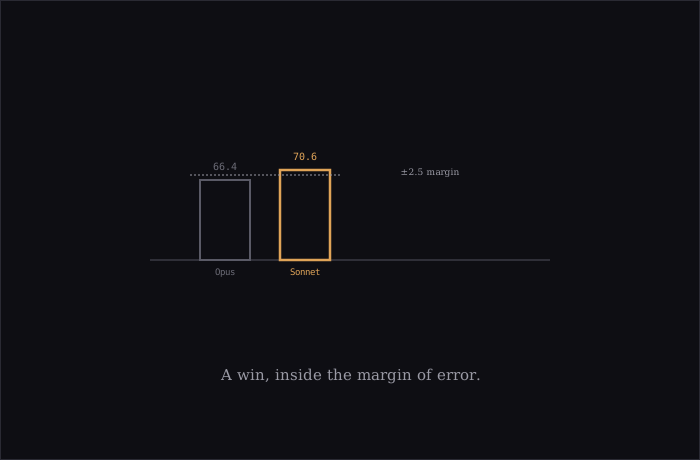
Anthropic’s own figures, as reported: 72.4% on OSWorld 2.1 computer use (Haiku 4.5 scored 15.7%), and 39.2% on Terminal-Bench 4.0 (Haiku 4.5 scored zero). For comparison, Sonnet 5.5 scores 70.6% on Terminal-Bench. The article also says Haiku 5.5 beats OpenAI’s GPT-6 Luna on every test where both were scored. All of this is vendor-run, not independent. If you’re picking a model for production, rerun your own tasks.
I also saw one aggregator quote a 1 million token context window, but the report I read didn’t state one, so I’d check Anthropic’s model page before relying on it.
Why a learner should care
The pattern in agent tools right now is a big model that plans and a small model that does the repetitive work. If the small one gets 90% cheaper on paper, the cost of running many sub-agents in parallel drops with it. I covered the larger model’s numbers in the Sonnet 5.5 benchmarks post.
Also reported: Max 5x subscribers get $100 a month in API credit, Max 20x get $200, and Team plans get up to $500 shared, aimed at people building their own agents.
Source: Resultsense.