Reflection AI raised about $2 billion on the promise of being America’s open frontier lab, and until now it hadn’t shipped a flagship model. On October 5 it introduced Beam. The headline is real, but so is the fine print, so I’ll separate them.
What’s been announced
According to TechCrunch’s coverage:
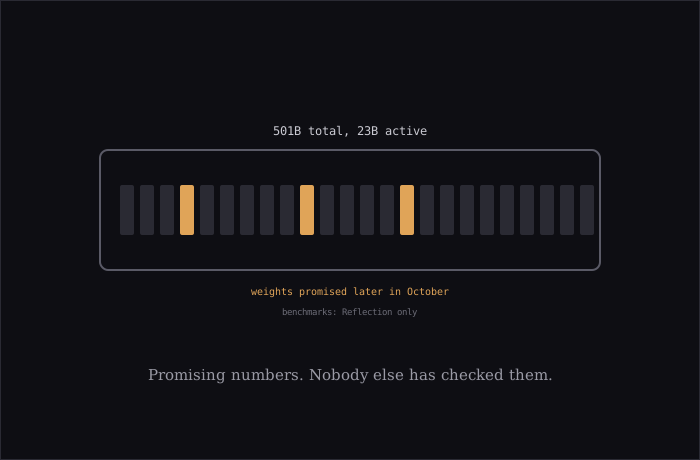
- 501 billion total parameters, mixture-of-experts, with 23 billion active per token
- Trained on 23.8 trillion tokens, text only
- A 1 million token context window
- Trained with “high-compute reinforcement learning” for reasoning, coding and agentic tasks
- Weights and a technical report promised later this month, with distribution through major cloud providers
For scale, TechCrunch compares it with Z.ai’s GLM-5.2, which is 744B total and 40B active. Beam is smaller in total and uses fewer active parameters, which is where the efficiency pitch comes from.
The license
DataCamp’s breakdown says the weights are committed to Apache 2.0: commercial use, redistribution and modification with no revenue thresholds. That’s about as permissive as open weights get. The key word is “committed.” As of that article, the weights weren’t on Hugging Face yet.
The numbers, and why to hold them loosely
Reflection claims Beam matches leading Chinese open models on advanced reasoning at 3-4x less inference compute. TechCrunch notes this has not been independently verified. The benchmark figures DataCamp lists are mixed:
| Benchmark | Beam | Note |
|---|---|---|
| SWE-bench Verified | 80.9 | competitive |
| Terminal-Bench v2.1 | 80.1 | Kimi K3 88.3, DeepSeek V4.1 Flash 90.6 |
| DeepSWE v1.1 | 44.4 | rivals listed at 68.0-74.2 |
| AIME 2026 | 97.8 | near parity |
DataCamp also flags that the efficiency claim leaves out prompt processing and serving overhead, that reinforcement learning used only a 256K context despite the 1M headline, and that the beta API caps requests at 262,144 tokens.
My read
For coding agents, the interesting thing is the pattern: strong on a familiar benchmark, noticeably behind on agentic ones. That doesn’t make it bad. It makes it a model whose real quality we can’t judge until the weights are out and people run their own tests. Open weights from a US lab under Apache 2.0 would matter a lot for anyone wary of Chinese-origin models in production, so I’ll be watching for the actual release.
Until then, the honest summary is: promising announcement, unverified claims.
Sources: TechCrunch, DataCamp.