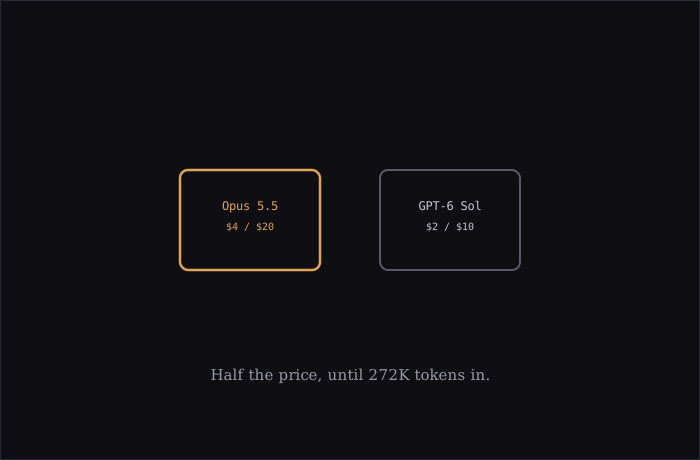
Anthropic shipped Claude Sonnet 5.5 on September 28, six days after Opus 5.5, at Sonnet 5’s existing $2/$10 price — exactly matching GPT-6 Sol’s rate card from the same week. The headline number Anthropic is leading with is a genuine jump worth taking seriously, and also a clean case study in exactly the composite-benchmark caution I wrote about a couple weeks ago.
The actual jump is real and large: Terminal-Bench 4.0 went from Sonnet 5’s 10.3% to Sonnet 5.5’s 70.6% — a genuinely dramatic generational improvement, not a marketing rounding trick. On SWE-Bench Pro, Sonnet 5.5 hits 81.3% against Sonnet 5’s 63.2%. Output generates more than 30% faster, and Anthropic says it costs up to 30% less per completed task even at the same per-token rate, because it needs fewer steps to finish comparable work.
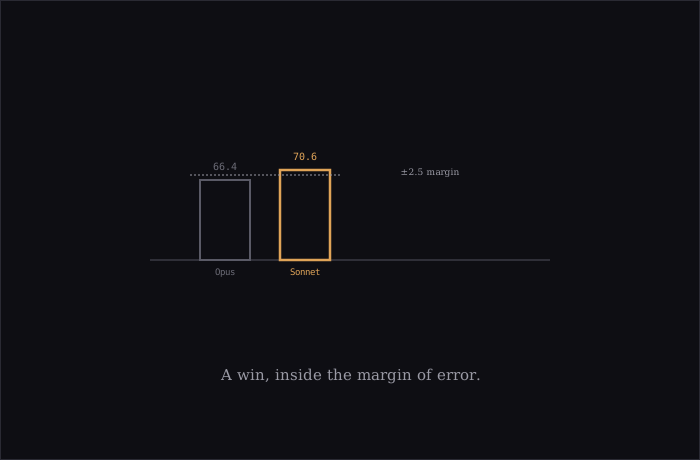
The specific claim worth scrutinizing is narrower: that Sonnet 5.5 beats Opus 5.5 on Terminal-Bench specifically, 70.6% to 66.4%. Anthropic’s own system card reports standard errors of roughly ±2.5 points for Sonnet 5.5 and ±2.6 for Opus 5.5 on this particular 66-task benchmark — meaning a 4.2-point gap sits close enough to that combined margin that calling it a clear win rather than a statistical tie is a real stretch. The comparison gets murkier once you check the actual test conditions behind each number: Anthropic’s own data shows safety-related fallback behavior affected roughly 1.5% of Sonnet 5.5’s trials but about 10% of Opus 5.5’s trials on this same benchmark — a meaningfully different intervention rate between the two models on the exact test being compared, which on its own could plausibly account for a chunk of that 4-point gap before any underlying capability difference even enters the picture.
The effort-level gap is the part most headline coverage skips entirely. Sonnet 5.5’s 70.6% is its best score, run at maximum reasoning effort. At the API’s actual default setting, Sonnet 5.5 scores 43.0% on the identical test — and Opus 5.5 at that same default setting scores 64.2%, comfortably ahead. Anyone calling the Sonnet API with default settings, which is most people not specifically tuning for this benchmark, is nowhere near the 70.6% headline number, and Opus 5.5 remains clearly stronger at that same default. The exact same effort-level sensitivity I flagged with Opus 5.5’s own Terminal-Bench score against Sol’s pricing — a model’s best possible number and its default behavior are genuinely different claims, and vendor comparison charts almost always lead with the former.
Where Anthropic’s own data is actually straightforward about the real gap: on SWE-Bench Pro specifically — large, multi-file changes in real repositories, arguably the most directly relevant test for this site’s coverage — Opus 5.5 leads clearly, 89.9% to Sonnet 5.5’s 81.3%. Anthropic isn’t hiding this; the company’s own positioning is that Sonnet 5.5 is the faster, cheaper everyday option that gets within a few points of Opus 5.5 on most agentic and office-work evaluations, while Opus 5.5 stays the pick specifically for large, open-ended coding and genuinely hard reasoning.
The practical read: Sonnet 5.5 at Sonnet 5’s old price, doing meaningfully better work, is a straightforwardly good upgrade for anyone already on that tier — that part of the announcement doesn’t need any asterisk. The one Terminal-Bench chart claiming an outright win over Opus 5.5, though, is exactly the kind of number worth checking the actual methodology behind before repeating as settled — a close benchmark result with a real, stated error margin and a documented fallback-rate difference between the two models being compared isn’t a clean win, it’s a result that happens to favor the cheaper model under the specific conditions it was measured in.