Anthropic shipped Claude Opus 5.5 on September 22. OpenAI answered with GPT-6 Sol and a budget model called Luna roughly ninety minutes later. Both launches led with cost, and it’s worth actually laying out what changed rather than repeating either company’s headline percentage.
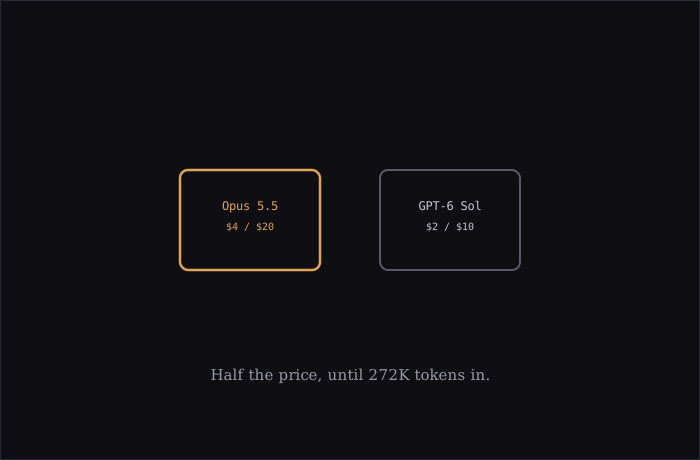
The list prices, plainly: Opus 5.5 runs $4 per million input tokens and $20 per million output, down from Opus 5’s $5 and $25 — a straightforward 20% cut on both ends. GPT-6 Sol runs $2 and $10, exactly half of Opus 5.5’s rate on both input and output. Luna, OpenAI’s budget tier, runs $0.10 and $0.50. Cached input reads landed at $0.20 per million tokens for both Opus 5.5 and Sol, so the caching discount doesn’t change the relative gap between them — Sol stays half the price of Opus 5.5 whether or not you’re hitting cache.
Where the “40% cheaper” claim actually comes from, and why it’s not the same thing as the price cut: Anthropic’s list-price reduction is 20%. The 40% figure the company is citing is a workload claim — combining the lower per-token price with lower token consumption at default settings on typical tasks, not a second discount layered on top of the first. That’s a meaningful distinction: the 20% is guaranteed by the rate card; the 40% depends on your actual usage pattern matching whatever Anthropic measured to produce that number.
The part that actually changes your bill without you choosing anything: Claude Code version 2.1.280, shipped the same day as Opus 5.5, made it the new default for Opus sessions, Opus subagents, and Opus-powered background work — and moved Pro and Team Standard subscribers from Sonnet to Opus by default in the same release. If you’re on one of those plans and hadn’t pinned a specific model, your default agent got meaningfully more expensive per token overnight, offset partly by Opus 5.5’s own price cut relative to Opus 5, but not offset relative to whatever Sonnet was costing you before the switch.
Why Sol’s headline price is genuinely half, but not simply “half the cost” in practice: Sol’s pricing steps up once a single input crosses roughly 272,000 tokens — a threshold that never comes up on short prompts but does on exactly the long-session, large-context work I’ve written about separately, where an agentic loop’s accumulated context routinely runs well past that size. Opus 5.5, by contrast, holds one flat rate across its full 1-million-token window regardless of how much of it a given request actually uses. For a quick task, Sol’s flat 2x price advantage holds cleanly. For a long agentic session pushing well past 272K tokens of accumulated context, the actual gap narrows, and modeling it accurately means checking where your own typical session size actually lands relative to that threshold — not just comparing the two headline numbers.
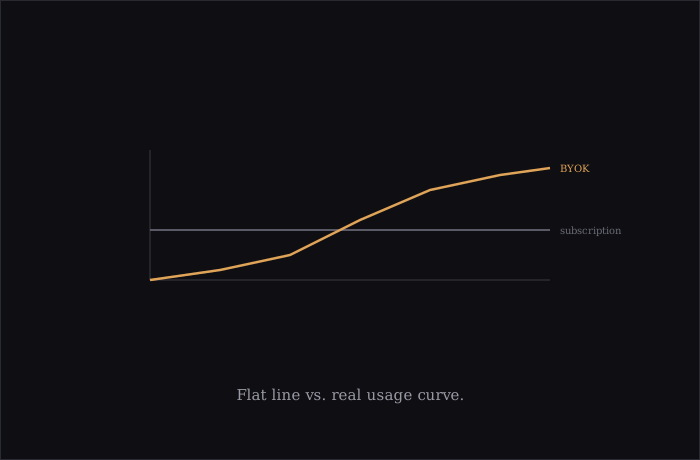
The practical takeaway isn’t “pick the cheaper one” — it’s that both companies’ percentage claims describe a specific measurement, not a universal one, and the same BYOK logic I laid out for routing tasks by actual cost applies here directly: a quick, short task and a long agentic session hit these two price structures differently enough that the right pick genuinely depends on which kind of work you’re actually running, not on which lab’s press release you read first.