If your AI agent is going to book a flight or check an order for you, the business on the other end has a reasonable question: who is this, and did the customer actually allow it? On October 6, Sierra and Meta announced a draft answer called the Personal Agent Protocol.
How it works, as announced
According to The Next Web, it is built on OAuth, the same family of standards behind “Sign in with Google.”
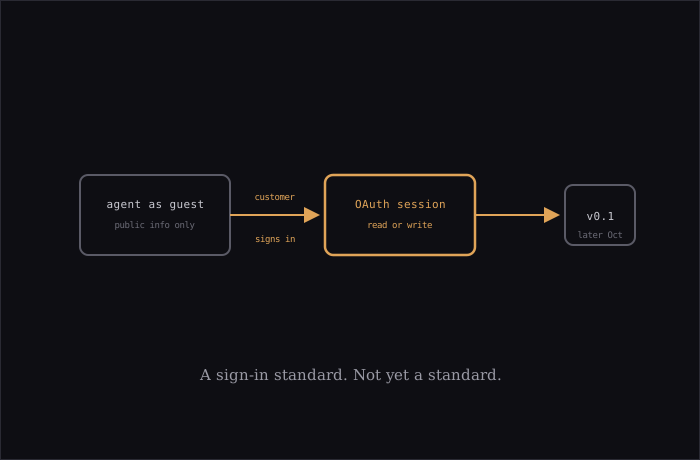
- An agent starts as a guest, able to look up public information.
- When the customer signs in, the agent can get read-only or write access, whichever the customer allows.
- The business decides how agents reach it: through its website, through APIs (using things like MCP and OpenAPI), or through the company’s own agent.
Named partners are Genesys, Instinct, Rocket, Shopify, Stripe and Walmart.
What it doesn’t do yet
This is the part I’d keep in mind before getting excited. It’s a draft, not a finished standard.
- A v0.1 specification is due later in October. Implicator reports that no spec, license or governing body has been published yet.
- Payments are a future extension, partly because of strong-customer-authentication rules in Europe. Push notifications and finer-grained permissions are also listed as future work.
- No European retailers, banks or payment companies are on the partner list.
It’s not the only protocol
Agent commerce is already crowded. Visa runs a Trusted Agent Protocol that Microsoft, Stripe, Shopify and Worldpay have joined, and Google has a Universal Commerce Protocol that Walmart and Shopify take part in. So Stripe and Shopify now sit in more than one camp, which tells me companies are hedging.
The notable absences are OpenAI and Anthropic. Sierra’s Bret Taylor reportedly acknowledged that and said he’d be disappointed if they didn’t adopt it.
My take as a learner
I keep seeing the same shape in this space: lots of competing “open” standards, each backed by a different set of big companies, with the developers who have to implement them stuck in the middle. MCP won mindshare for connecting agents to tools because it was simple and widely adopted. The question for this one is whether OAuth-based sign-in is enough of an advantage to get past the others, or whether it ends up as one more checkbox that merchants add.
For now, there’s nothing to install. The useful thing is to read the v0.1 spec when it lands and see whether agent identity is handled in a way that works with whatever agent you already run.
Sources: The Next Web, Implicator.