Of everything that crossed my feed this week, this is the one I keep rereading, partly for the headline number and partly for how much of the story is in the fine print.
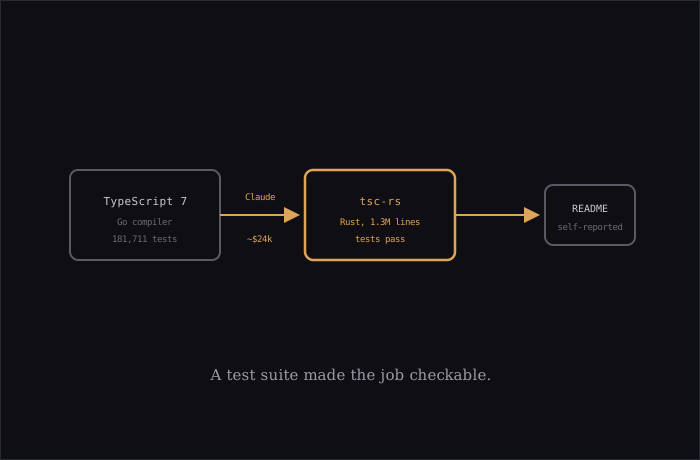
Theo Browne, founder of Ping Labs, published tsc-rs (also called ts-rust), a Rust port of the TypeScript 7 compiler, type checker and language server. The code lives under the pingdotgg GitHub organization. I couldn’t open the repository directly while writing this, so everything below comes from two write-ups of its README (AI Weekly and Diario Bitcoin). Treat the figures as “as the README reports them.”
The claims
- All 181,711 ported compiler tests pass, and the port was checked against 120 open-source repositories.
- It is over 1.3 million lines of Rust. The README reportedly says the author has “never read a line of this code.”
- A first attempt with OpenAI’s Codex models reportedly burned $400,000 to $420,000+ in API tokens over months and stopped around 84% compatibility. (Browne’s own post says about $400k; the README says more than $420k. The sources don’t explain the gap.)
- Claude Opus 5.5 then produced a working first version in about 10 hours, starting from scratch, and the finished run cost about $24,047 over two weeks.
The speed numbers need care
The reported figure is 1.61x faster than TypeScript 7 and 11.4x faster than TypeScript 6, as geometric means across real projects. Those use different baselines, so “11x” and “1.6x” are not the same claim. On one project, the median of five runs was 7.25 seconds against 16.10 seconds for tsc 7. Diario Bitcoin adds that Bun’s own checker was faster in five of the six projects tested.
What the README itself admits
- Memory grows about 20 MiB per 1,000 edits in long sessions.
- Binaries exist only for Linux x64 and macOS arm64.
- Timing varies in monorepos, and multi-project builds can show stale output.
- It does not yet replace
tsceverywhere.
Why I think this works at all
My reading, not the author’s claim: the port had a huge existing test suite to aim at. When an agent can run 181,711 tests after every change, “is this right?” stops being a judgment call. That likely explains why a model could finish a job on which an earlier, far more expensive attempt had stalled, though the sources don’t say what differed between attempts besides the model.
The open question that sticks with me is how much human steering the test passes needed. A passing suite is strong evidence, but it isn’t the same as someone understanding the code. Before you swap this into a real build, run it beside tsc on your own project and compare the diagnostics.
Sources: AI Weekly, Diario Bitcoin.