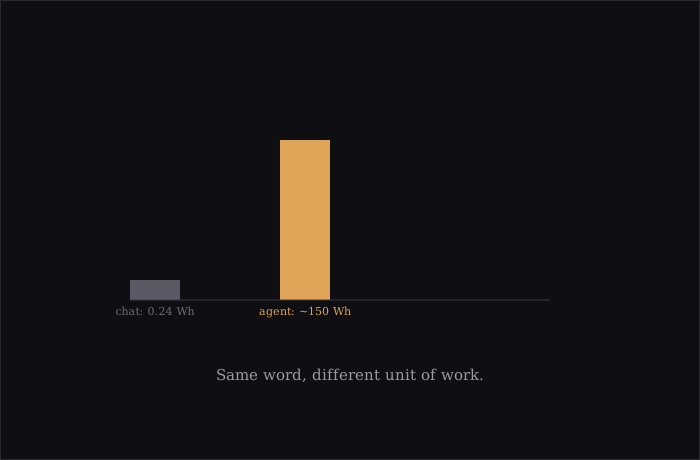
The energy-per-AI-query numbers that get quoted constantly — Google’s oft-cited 0.24 Wh for a median Gemini text prompt — describe a single chat exchange. A question in, an answer out. Climate scientist Zeke Hausfather wanted to know what the real number looks like for how he actually uses AI day to day, so over eight weeks he logged every one of the 1,138 prompts he typed into Claude Code and worked out what they actually cost in electricity.
The gap was enormous. His 1,138 prompts triggered more than 14,000 individual model calls — an average of 12 per prompt — processing a combined 3.2 billion tokens. His best estimate: roughly 170 kWh of data center electricity across the eight weeks, working out to about 150 Wh per prompt, with a wide uncertainty band (60–290 Wh) since none of the frontier labs publish real per-token energy figures to check the math against. That’s somewhere around 600 times a typical chat prompt, not because agents are wasteful in some obviously fixable way, but because a coding agent and a chat query aren’t measuring the same unit of work. A “prompt” to an agent kicks off a whole chain of planning, tool calls, file reads, and self-checks — his logs showed 96% of those 3.2 billion tokens were cache reads, because the agent re-reads its accumulated context at every single one of those 14,000 steps.
Put in terms people actually feel: his median session ran about 0.6 kWh, roughly fifty times what it takes to charge a phone. A full day of heavy use hit 1.2–5.9 kWh — more than the daily draw of two refrigerators. Projected across a year of similarly intensive use, Hausfather figures the emissions land somewhere near what a household clothes dryer produces.
He’s not alone in trying to put a real number on this. A separate developer built and open-sourced a tool called claude-carbon specifically because Anthropic — like every frontier lab — doesn’t publish per-inference energy data, so there was nothing to check anyone’s assumptions against. Running it against six months of his own usage: 893 sessions, roughly 970 kg of CO2e total, a median around 200 g per session, and a long tail — his single worst session hit 68 kg on its own.
Worth being precise about what this is and isn’t. It’s not a claim that Claude Code specifically is unusually wasteful — Hausfather’s whole point is that the low official per-prompt figures Google and OpenAI publish are accurate for what they measure, a single chat exchange, and simply don’t describe what an agentic workflow does. Any comparably agentic tool doing dozens of tool calls and re-reading a growing context window at every step would show the same pattern. It’s also an estimate, not a lab measurement — actual per-token energy use at frontier labs isn’t public, so both Hausfather’s figures and claude-carbon’s are best-effort reconstructions with real uncertainty attached, not verified ground truth.
What it does add up to: as agentic AI moves from occasional chat queries toward hours-long autonomous sessions, the industry’s standard “energy per prompt” figure is measuring less and less of what people are actually running.