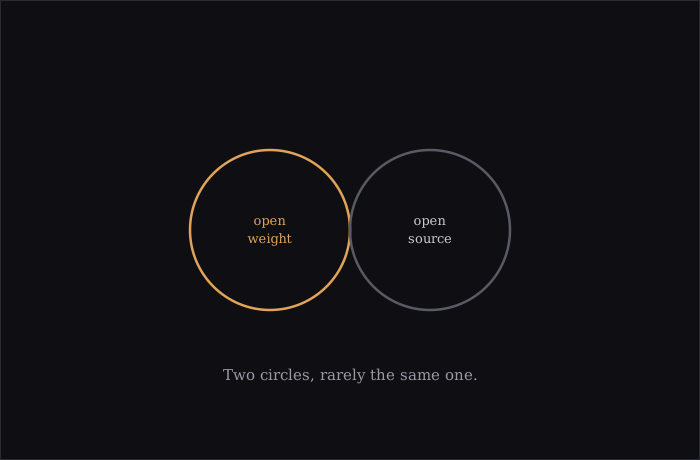
Three separate posts on this site — MiniMax’s license, ZCode’s branding, and Warp opening its terminal client — all turned out to be versions of the same underlying confusion. It’s worth naming the actual distinction directly instead of relitigating it every time it shows up under a new name.
Open weight means the trained parameters of a model are published and downloadable — you can run inference locally, fine-tune it, inspect it. That’s a real, meaningful form of openness. It says nothing about the license terms attached to those weights, and nothing at all about whatever application, service, or agent harness someone builds around the model. MiniMax M2.7’s weights are a clean example of open-weight-but-not-open-source in practice: downloadable, inspectable, and licensed in a way that requires MiniMax’s written permission for commercial use — genuinely open in one specific sense, genuinely restricted in another that a casual reader wouldn’t catch from “modified MIT” alone.
Open source, properly used, describes code released under a license — MIT, Apache 2.0, GPL, AGPL, one of the recognized OSI-approved terms — that grants the actual freedoms the phrase implies: use, study, modify, redistribute, including commercially, without asking permission first. I went through what those specific licenses actually restrict here if you want the practical breakdown. Applied correctly, it’s a legal fact about a specific piece of code, not a vibe about how open a company seems.
The trap is treating either one as if it describes the whole product. ZCode got called open source in roundup after roundup because GLM-5.3’s weights are MIT — but ZCode the application is a closed, paid desktop tool; only its plugin marketplace repo is actually published anywhere. Warp’s situation runs the opposite direction: the terminal client genuinely is open, AGPL and MIT, real licenses with real teeth. But Oz, the cloud platform actually doing the agentic orchestration work Warp’s whole pitch depends on, stayed fully proprietary the entire time. Same underlying confusion, pointed in opposite directions — one open layer got mistaken for a whole open stack, twice, from two different sides of the equation.
A more useful question than “is this open source”: how many separate layers would need to stay unchanged for your access to keep working the way it does today — the license on the weights, the license on the harness code around them, the runtime you actually execute it in, who controls the compute it runs on, and who owns whatever orchestration layer ties it together. A tool can be open on the first layer and locked on all four of the rest, and “open source” as a one-word label won’t tell you that. Reading the specific license text on the specific component you’re actually depending on will.