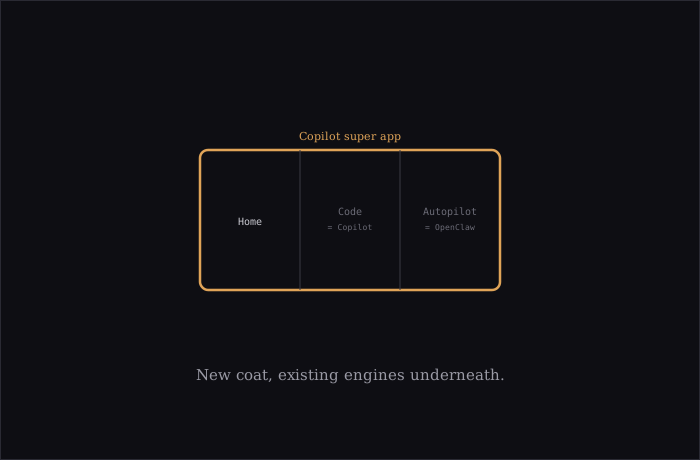
Microsoft relaunched Copilot on September 25 as a unified “super app” — Home, Code, and Autopilot in one tabbed interface, folding the separate consumer and Microsoft 365 Copilot apps into a single product. CEO Satya Nadella called it “a new OS for work.” Worth pulling apart what’s actually new here versus what’s existing technology I’ve already covered, wearing a new name.
The three tabs, plainly: Home merges chat with Cowork, Microsoft’s task-delegation feature, and embeds full Word, Excel, and PowerPoint directly in the interface. Code lets non-technical users describe an app, dashboard, or automation in plain language and get a working result. Autopilot is a persistent “digital teammate” living inside a company’s Microsoft 365 tenant, with its own identity, memory, and dedicated compute — customizable name, tagged into project chats the way you’d tag a human coworker.
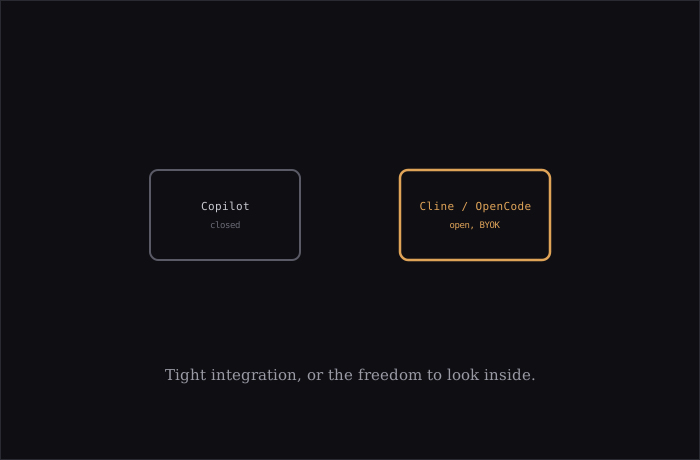
Code is explicitly built on technology I’ve already written about directly: Microsoft’s own materials describe it as running on “the same underlying technology as GitHub Copilot” — the tool I covered in its own dedicated post a week ago, comparing it directly against the open-source alternatives this site focuses on. This isn’t a new coding engine; it’s GitHub Copilot’s existing capability, repackaged as a plain-language app-and-dashboard builder for people who don’t think of themselves as developers at all.
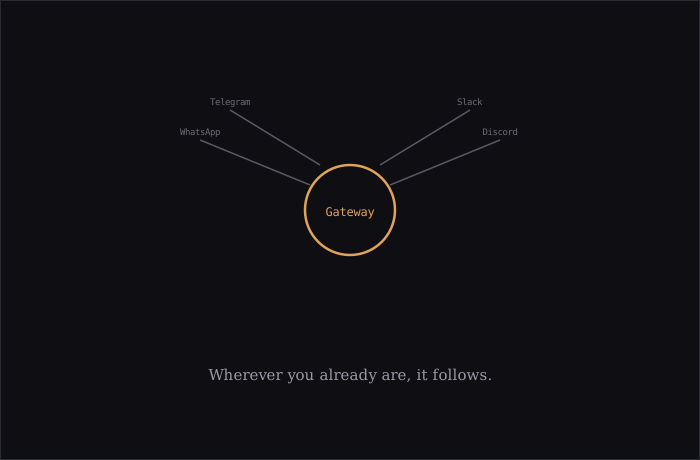
Autopilot is the more interesting thread, and the one most coverage of the launch undersold: it’s a rebrand of Scout, the agent Microsoft first unveiled at Build earlier this year — and Scout itself is built on OpenClaw, the self-hosted, messaging-native agent platform I covered a few weeks back. That’s a direct, concrete instance of exactly the pattern I described when writing about OpenClaw originally: a capable open-source agent core showing up repackaged and re-branded inside a major company’s own commercial product, rather than every vendor building an always-on agent from scratch. Microsoft didn’t build a new agent architecture here — it built a persistent-identity, enterprise-governance layer (memory, compute isolation, tenant-level controls, and ties into Microsoft’s separate Agent 365 governance product) on top of an existing open foundation.
The pricing model is worth naming since it’s a real, current example of exactly the usage-based billing shift I covered with Opus 5.5 and GPT-6 Sol: a flat $30-per-user license covers chat and Office features, while Cowork, Code, Autopilot, and frontier model access — Astra and Fable specifically among the options — run on usage-based billing through Copilot Credits, with spending caps companies can set themselves. The subscription tier buys you the interface; the actual agent work is metered separately on top of it.
Where this fits the broader pattern I keep tracking across vendors: OpenAI fused Codex directly into the ChatGPT app in July. Anthropic merged Cowork with Claude chat the week before this Microsoft launch. Yesterday’s OpenAI DevDay shipped “dots,” its own always-on agent with a dedicated cloud computer. Microsoft’s super app is the fourth major lab converging on the identical shape within about two months — chat, coding, and a persistent background agent, unified into one interface — all four companies apparently reaching the same product conclusion independently, or more plausibly, all four watching each other’s roadmaps closely enough that none of them could afford to ship the old, separated version of these tools any longer.
The honest take: genuinely useful consolidation for Microsoft’s enterprise customers, and a sign that “chat plus coding plus an always-on background agent” has settled into the default shape every major vendor now ships — but worth recognizing that two of the super app’s three pillars are existing technology this site has already covered directly, now sitting under a single new coat of Microsoft branding.