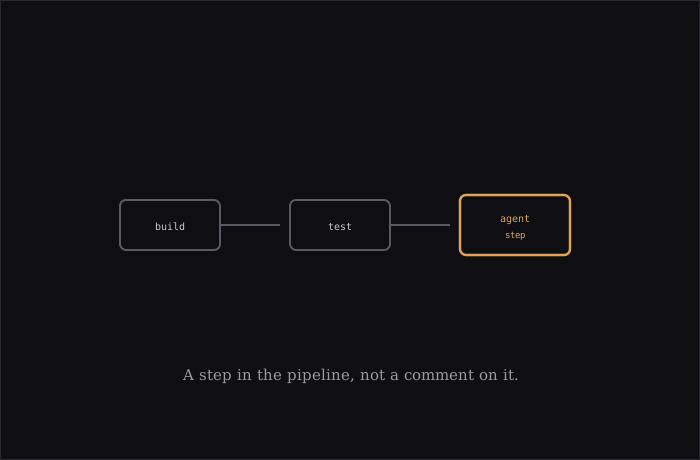
GitHub Actions has supported bolted-on AI bots for a while — a workflow step that calls out to an API and posts a comment. Agentic Workflows, which GitHub just moved into technical preview, is a different shape of integration: an agent as a native step in the pipeline itself, with the same access to the checkout, the same conditional logic, and the same place in the sequence as any other job.
The stated use cases are the unglamorous, high-volume work that tends to get skipped under time pressure: issue triage, documentation upkeep, and code-quality checks running automatically as part of the same pipeline that already runs your tests, rather than as a separate bot commenting from outside after the fact. The distinction matters mechanically, not just semantically — a step that runs inside the workflow can gate on its own output, run conditionally based on what earlier steps produced, and fail the build the same way a test can, instead of just leaving an asynchronous comment for a human to notice later or ignore.
This lands in the same general direction as the parallel-agents trend I wrote about a few days ago — Cline’s Kanban board, Qwen Code’s coordination modes, Copilot’s own /fleet — but it’s a different axis of the same shift. That earlier post was about running several agents on one task at once. This is about agents becoming infrastructure: a standard, expected piece of the pipeline every repo already runs, rather than a tool a developer opens separately to ask something.
Worth flagging plainly since it’s still in technical preview: an agent that gates or fails a build is a meaningfully bigger blast radius than one that leaves a comment. A bot that hallucinates in a PR comment wastes a reviewer’s few minutes; an agentic step wired into a required check can block or waste an entire pipeline run if it gets something wrong, and the more automatic and pipeline-native these steps become, the more that failure mode looks like the same trust-the-agent’s-output pattern that’s shown up in nearly everything else I’ve covered from this angle this month — just moved one layer up, from a single agent’s sandbox to the CI system that decides whether code ships.