I keep running into Langflow whenever I look at how people are actually building agents rather than just calling an API directly. It’s a low-code, node-based builder — you wire up prompts, tools, and models on a canvas instead of writing the orchestration by hand, and it stays Python underneath so you’re not locked into the UI if you eventually need to eject from the visual layer.
Version 1.11, released July 22, 2026, is mostly about giving up some control on purpose.
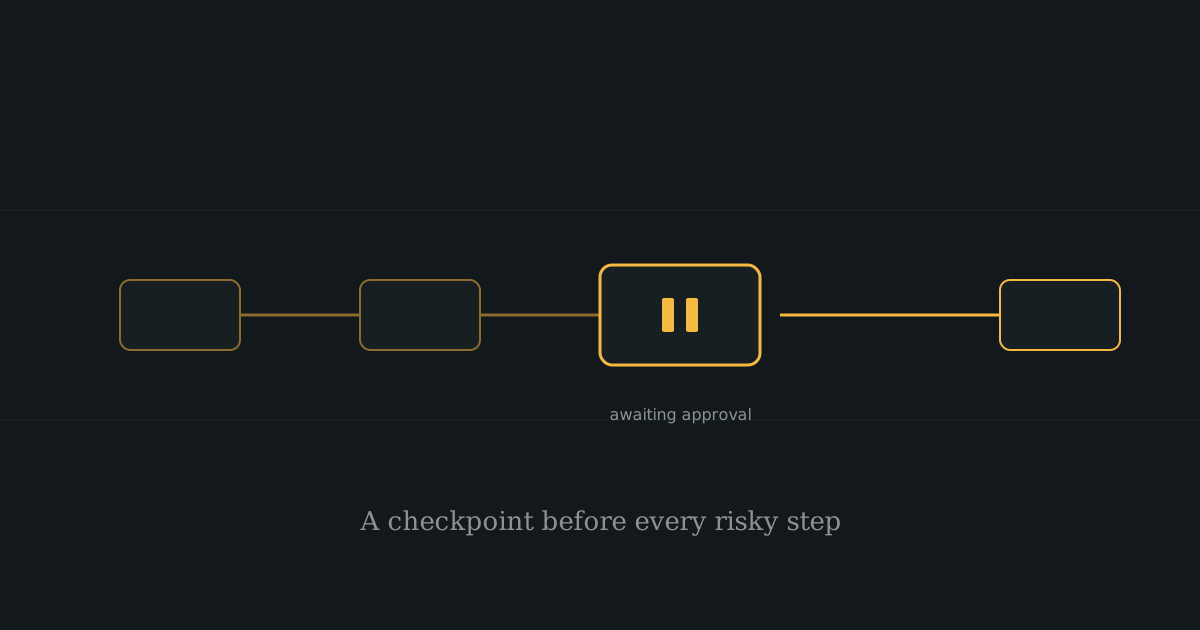
The headline feature is Human-in-the-Loop (HITL): when a flow’s agent calls a tool, it can now pause, save a checkpoint of its state, and wait. A person then approves, rejects, or edits the request before the agent picks back up exactly where it left off. For anything that touches a real system — sending an email, hitting a paid API, writing to a database — that’s a meaningful difference from “the agent just did it and you find out after,” and it’s the same underlying idea I keep seeing show up under different names across this space: more autonomy, but with an actual off-ramp built in rather than bolted on as an afterthought.
Two other changes came in the same release:
- A2A protocol support — flows can now be published so other agents can call them, and a flow can call out to remote A2A agents itself. It’s off by default; you have to set an environment variable to turn it on, which feels like the right default for something that opens up inter-agent calls.
- AG-UI streaming on the Workflow API — the v2 Workflow API (still in beta) now supports streaming responses in the AG-UI format, for anyone building a front end that shows a flow’s output as it happens rather than waiting for the whole thing to finish.
A couple of breaking changes are worth flagging if you’re upgrading: the old default superuser password is gone (you now have to set one explicitly, or let auto-login generate one), and components that need PyTorch aren’t bundled by default anymore — they’re opt-in installs, which should shrink the default install footprint noticeably for anyone who doesn’t need them.
Separately, and not really about this release, but worth knowing if you’re evaluating whether to build on Langflow long-term: IBM has announced plans to acquire DataStax, Langflow’s parent company. Nothing about the open-source project’s licensing has changed as far as I can tell, and IBM has generally left acquired open-source projects to keep operating under their existing governance — but it’s the kind of ownership change worth keeping an eye on, for the same reason Continue.dev’s acquisition by Cursor turned out to matter more than it looked like at first.
Try it
uv pip install langflow
langflow run
Full release notes are on the Langflow blog and docs release notes page.