I mentioned graph-based retrieval as the frontier past plain RAG a few days ago without a concrete example to point at. Graphify, trending hard this week, is exactly that example, built specifically around a claim plain RAG can’t make: every connection it shows you comes with an explanation of where it came from.
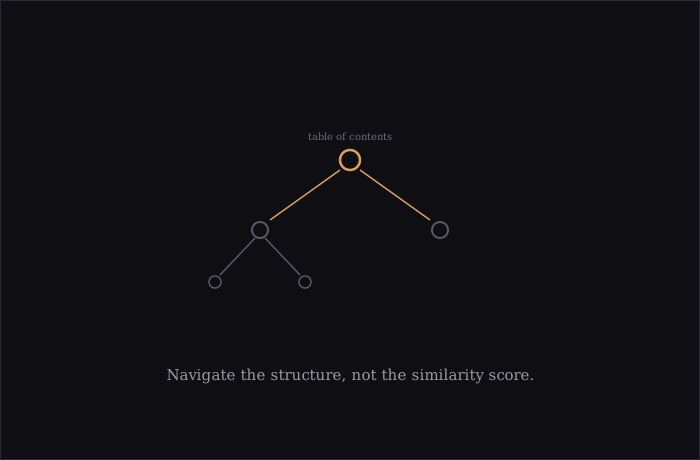
The core pitch is refusing the usual approach entirely: type /graphify inside your coding agent, and instead of chunking your codebase into embeddings and searching by similarity, it parses the actual code with tree-sitter — a real abstract syntax tree, deterministic, no LLM involved, nothing leaves your machine — and builds a genuine graph out of it: files, functions, and concepts as nodes, the actual relationships between them as edges. Docs, PDFs, images, and video get a semantic pass from your assistant’s own model since those aren’t structured enough for AST parsing, but the code itself needs no model at all to map correctly.
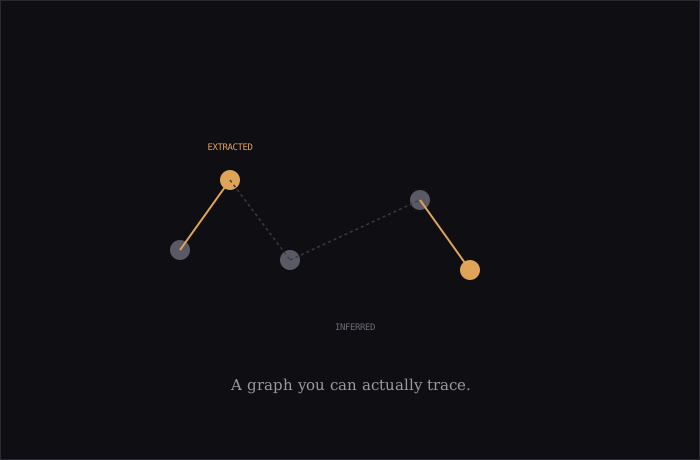
The detail that actually justifies calling this a meaningfully different approach rather than just RAG with extra steps: every single edge in the graph is tagged either EXTRACTED or INFERRED — extracted meaning it’s explicit in the source itself, inferred meaning Graphify resolved it through its own reasoning. That’s a genuinely different guarantee than a vector search returning a similarity score. A similarity score tells you how close two chunks of text landed in embedding space; an EXTRACTED tag tells you the connection is directly, verifiably in the code, and an INFERRED tag tells you exactly when to double-check Graphify’s own reasoning instead of trusting it blindly.
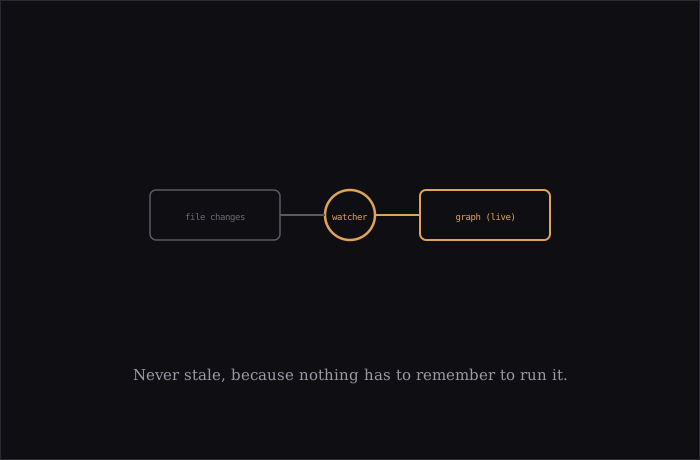
Once built, the graph is genuinely queryable rather than just a static visualization — graphify query "what connects auth to the database?", graphify path "UserService" "DatabasePool" to trace a specific route between two components, graphify explain "RateLimiter" for a plain-language walkthrough of one piece. It also generates an interactive HTML visualization, a Markdown wiki, and Mermaid architecture diagrams that regenerate automatically on every commit if you install the git hook — a genuinely useful side effect for keeping documentation from going stale, on top of whatever your agent uses the graph for directly.
It ships as an actual Agent Skill — .claude/skills/graphify/SKILL.md when installed project-scoped — working across Claude Code, Cursor, Codex, and Gemini CLI, with a separate extension already built for Pi specifically. The stated reason coding agents need this at all is a real, common failure mode: faced with an unfamiliar codebase, an agent’s default instinct is broad raw grep, which burns tokens fast and still misses the actual architecture connecting what it finds.
It’s worth being clear-eyed that this doesn’t replace retrieval for everything — a knowledge graph built from AST parsing is exactly suited to code, where relationships are explicit and structural, and much less suited to the kind of loosely-connected natural-language knowledge base plain RAG was built for in the first place. What Graphify actually demonstrates is that “vector search” and “retrieval” aren’t the same word — for a domain with real, extractable structure sitting right there in the source, skipping the embedding step and building the actual graph can be both more accurate and more honest about what it does and doesn’t know.