I kept writing “MCP support” into posts on here for weeks before I actually sat down and understood what the term is doing, so here’s the explanation I wish I’d read earlier.
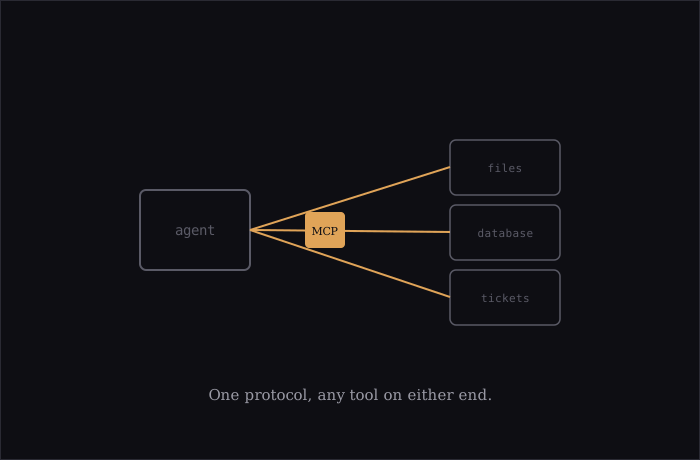
The problem MCP solves: an AI agent is only as useful as what it can actually touch. It can read the conversation you’re having with it, and whatever the model itself was trained on, but it has no built-in way to look at your Slack messages, query your database, or check a ticket in Linear. Before MCP, every tool that wanted to connect an agent to some external system had to write custom, one-off integration code for that specific combination. Agent A talking to database B needed its own glue code, and none of it was reusable — build the same integration again for Agent C, and you started from scratch.
What MCP actually is: a standard way for an agent to discover and call external tools, regardless of which model is doing the reasoning or which service is on the other end. Anthropic originally built and open-sourced it, but it’s not Claude-specific anymore — it’s become something closer to a shared plumbing standard, the same way HTTP doesn’t care which browser or server you’re running. An “MCP server” exposes a set of capabilities (read this file, query this API, search this index); an “MCP client” — which is usually the coding agent itself — can discover what’s available and call it, using the same protocol no matter what the server is or which model is driving the client.
Why it matters practically: it’s the reason a tool like Qwen-MM-Plugins can ship one plugin that adds multimodal capabilities to seven different agents at once, instead of writing seven separate integrations. It’s why you can point Claude Code, Cline, or OpenCode at the same self-hosted database tool and have all three just work. Once both sides speak MCP, the connection is basically free.
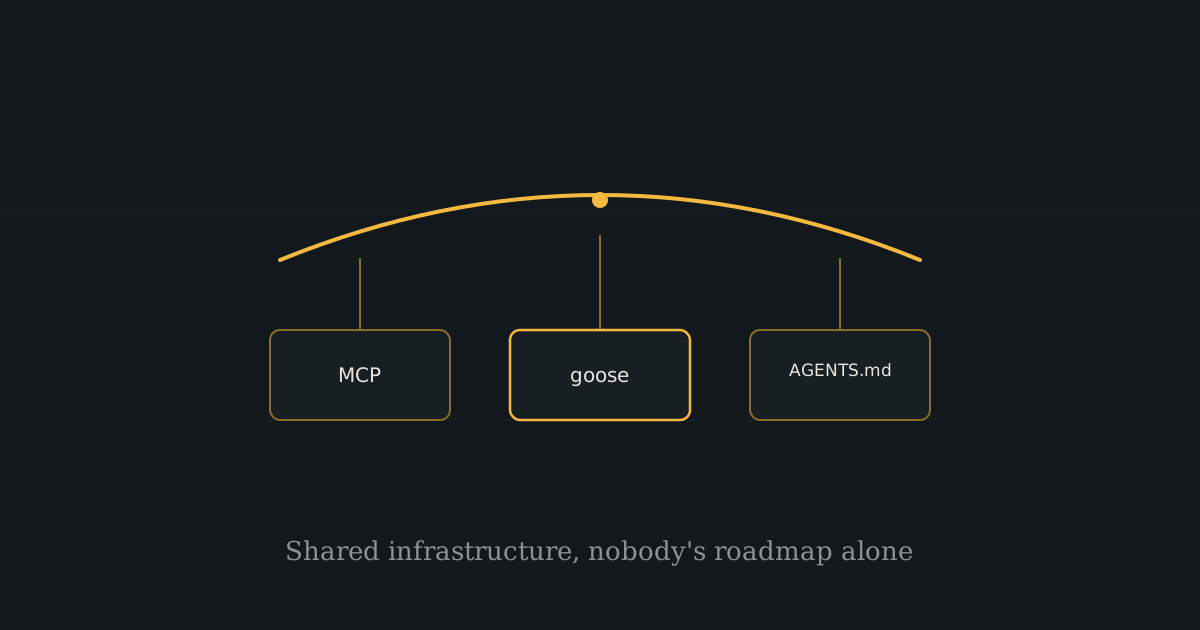
It’s also not Anthropic’s to unilaterally change anymore. The protocol moved to neutral, foundation-level governance in December 2025, alongside Block’s goose and OpenAI’s AGENTS.md convention — I wrote about that transition separately, and it matters here specifically because it’s part of why MCP has become safe enough for competing companies to build on without worrying one of them will quietly steer it toward their own advantage. The public server registry has already passed 10,000 entries, which is the kind of scale where governance actually matters rather than being a formality.
It’s not magic, and it’s not doing any reasoning on its own — it’s closer to a really well-designed plug shape than an intelligence layer. But a huge amount of what makes the current generation of coding agents feel more capable than last year’s isn’t the models getting smarter, it’s this kind of plumbing finally existing so agents can actually reach the things they need to, without every team reinventing the same connector from scratch.