BYOK shows up in the frontmatter-adjacent description of basically every tool I’ve covered here, so it’s probably worth actually explaining instead of assuming everyone already knows.
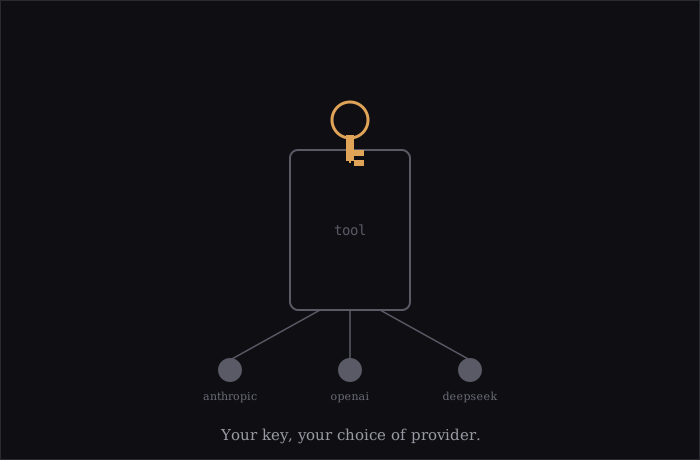
What it means, literally: the software itself is free, but it doesn’t come with any model access bundled in. You sign up for an API key from whichever provider you want — Anthropic, OpenAI, Google, DeepSeek, or a smaller aggregator — paste it into a config file, and the tool uses that key to actually run the model. The agent is just the harness: the part that reads your codebase, decides what to edit, and manages the back-and-forth. It’s not the part doing the thinking, and it’s not the part you’re paying a subscription to.
Why almost every open-source agent works this way: running a frontier model costs real money per request, and an open-source project maintained by volunteers or a small team generally can’t subsidize that for free the way a well-funded company temporarily can. BYOK sidesteps the whole problem — the tool never touches your money, and you pay the model provider directly at whatever rate they set.
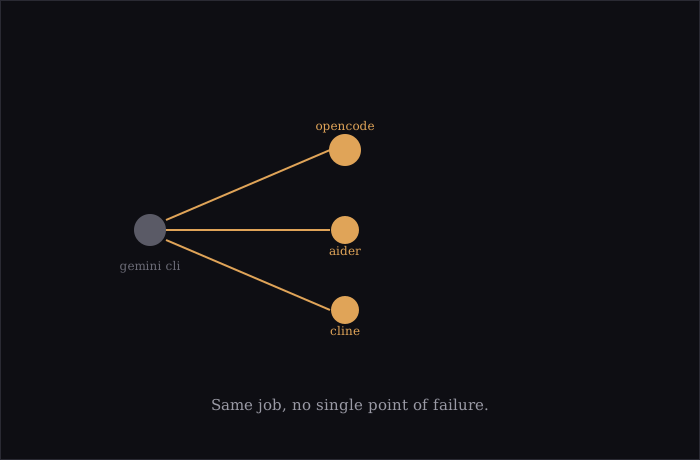
This is also the actual reason these tools can’t be shut off the way Gemini CLI just was. Gemini CLI wasn’t BYOK in practice — it ran on Google’s own subsidized backend, so when Google decided to redirect free users to Antigravity, there was nothing left running underneath the open-source code. Aider, OpenCode, and Cline don’t have that failure mode. If Anthropic changed its API pricing tomorrow, you’d just point the same tool at OpenAI or DeepSeek instead. The tool doesn’t care, because it was never wired to just one provider’s goodwill in the first place.
BYOK isn’t automatically bulletproof, though. OpenCode found this out when Anthropic closed off the specific unofficial channel it had been using to ride on consumer Claude subscriptions — not a BYOK failure exactly, but a reminder that “model-agnostic” only protects you as far as every connection it relies on is actually the kind you’re supposed to have. The fix in that case was the same fix BYOK is built around generally: don’t depend on one door staying open, build enough alternatives that losing any single one is an inconvenience, not a shutdown.
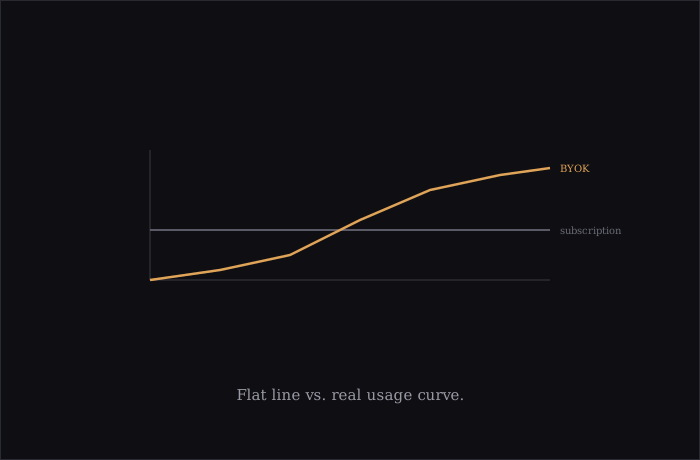
The tradeoff is obvious once you say it out loud: BYOK tools are free as software but not free to run, and you’re the one managing multiple API keys and watching multiple bills instead of one flat subscription. For a lot of people that’s a fair trade for not being one executive decision away from losing the tool entirely — which, six months into tracking this space, keeps turning out to be less of a hypothetical risk than it sounds.