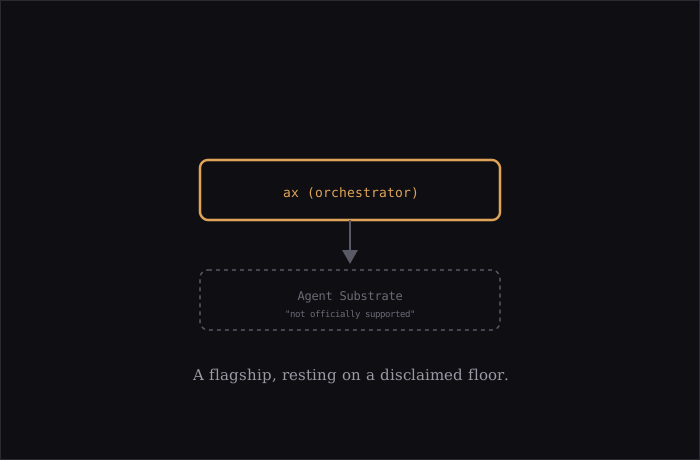
Writing about Google’s AX orchestrator meant running into a phrase worth explaining on its own: the project AX depends on entirely to actually execute anything, Agent Substrate, carries the label “not an officially supported Google product” right in its own repository. That phrasing shows up constantly across Google’s open-source output, and it’s worth being precise about what it does and doesn’t tell you.
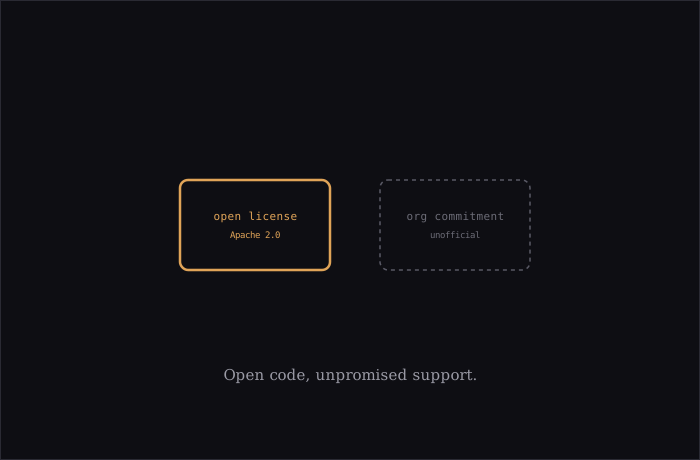
What the label is actually protecting Google against: a support and commitment expectation, not a quality or seriousness signal. An “officially supported” Google product typically comes with things like a dedicated support org, defined SLAs, a roadmap Google is accountable for delivering on, and an implicit promise it won’t just disappear without warning. The “not officially supported” label is Google explicitly declining to make those specific promises — not a statement that the code is untested, unmaintained, or built by a side team on their own time. Plenty of large companies’ most actively developed open-source infrastructure carries exactly this disclaimer, precisely because “officially supported” is a heavy organizational commitment most internal teams releasing research work were never authorized to make in the first place.
Why this specific gap matters more than it might seem: it’s a dependency relationship, not just a label on the thing that’s disclaimed. AX itself doesn’t carry this warning — only Substrate, the layer AX depends on entirely to run any actual workload, does. That’s worth noticing on its own: the outer, more polished layer gets treated as the flagship, while the foundation it’s built on sits one support tier lower, disclaimed by the same organization shipping both. If Substrate’s priorities shift internally, or the team behind it moves to something else, AX inherits that risk even though AX’s own repo makes no equivalent disclaimer about itself.
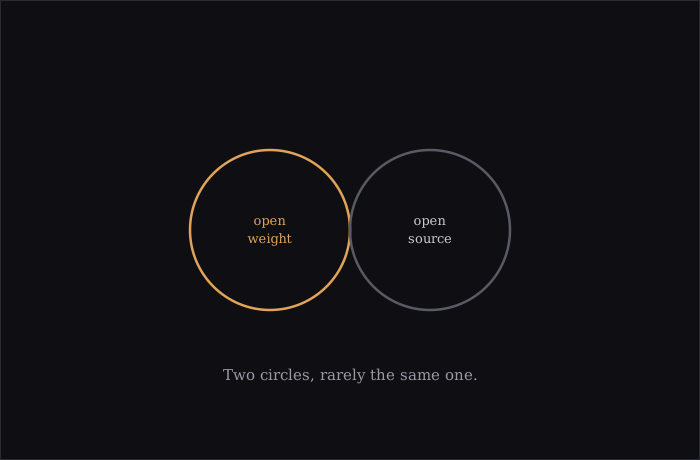
How this compares to labels I’ve covered elsewhere on this site: it’s a different kind of gap than open weight versus open source — that distinction was about what legal permissions actually apply to a piece of code or a model. This is about organizational commitment layered on top of code that might be fully, genuinely open source under a real license like Apache 2.0. AX and Substrate are both legitimately open — you can read every line, fork either one, run them independently of Google entirely. “Not officially supported” doesn’t touch any of that. It’s specifically about whether Google, as a company, is on the hook if the project stalls, changes direction, or needs a fix nobody inside the company is actually tasked with providing.
The practical read if you’re evaluating whether to build on something carrying this label: check who’s actually committing code and how consistently, not just whose name is on the organization account. A project can be genuinely well-maintained by a dedicated internal team while still correctly carrying this disclaimer, because the label is about formal commitment, not about current reality. The risk it’s flagging is specifically about the future — what happens if that team’s priorities change — not a claim about the present quality of what they’ve built.