
Short answer: Flint is the first model from Recursive, released around Oct 21 as open weights under Apache 2.0. It is a mixture-of-experts coding model with 39.8B total parameters and about 2.5B active per token, built to run locally for coding agents. Quantized versions are about 22 to 23 GB, and Recursive lists a 48 GB Apple Silicon machine or a 48 GB NVIDIA GPU for local use. Almost every score and speed figure is Recursive’s own, measured on its own harness, so treat them as claims until independent tests appear.
What is Flint?
Per MarkTechPost, Flint is a text-only, decoder-only mixture-of-experts Transformer with 49 layers and 256 routed experts, six of which the router picks per token, plus one always-active shared expert. It supports reasoning and OpenAI-compatible tool calls. Compatible runtimes include llama.cpp, Ollama, Unsloth, LM Studio, vLLM and SGLang. AI Weekly lists a Hugging Face repository and the Apache 2.0 license.
How good is it, and who measured it?
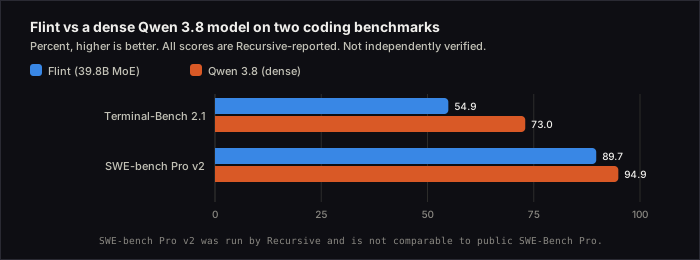 All scores are Recursive-reported. Not independently verified.
| Benchmark (Flint, BF16) | Score |
|---|---|
| SWE-bench Verified | 74.2% |
| SWE-bench Pro v2 | 89.7% |
| Terminal-Bench 2.1 | 54.9% |
| LiveCodeBench v6 | 80.3% |
| IFEval | 95.1% |
| IFBench | 89.2% |
Recursive says Flint tops its chart among MoE models under 50B on agentic coding but trails the strongest dense models. On Terminal-Bench 2.1 a dense Qwen 3.8 scores 73.0% against Flint’s 54.9%, and on SWE-bench Pro v2 94.9% against 89.7%. Two cautions from MarkTechPost: the SWE-bench Pro v2 scores were measured by Recursive and are not comparable to public SWE-Bench Pro, and competitors’ Terminal-Bench numbers in the comparison table come from a different version (v2.0) than Flint’s (v2.1).
Will it run on my machine?
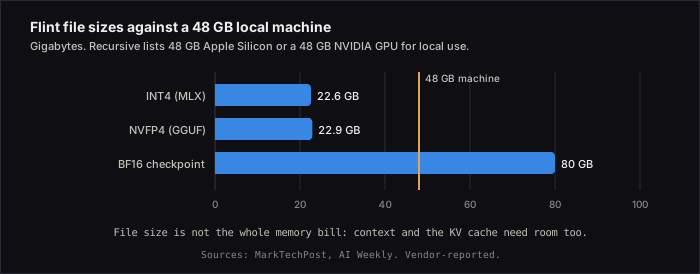
Sizes listed: INT4 for MLX about 22.6 GB, NVFP4 GGUF about 22.9 GB, and the BF16 checkpoint about 80 GB. For local use Recursive lists 48 GB Apple Silicon (M4 Pro, M5 Pro or M5 Max) or a 48 GB NVIDIA GPU. The full BF16 model needs one B300 or H200 GPU per replica. File size is not the whole memory bill, because context and cache need room too. For other models by memory size, see our hardware guide to open-weight coding models. A comparable 24 GB option is Nemotron 3.5 Bolt.
How fast is it?
Recursive claims over 125 tokens per second on an M4 Pro MacBook Pro and over 150 on a 64 GB NVIDIA RTX Spark, both at short context. It says that is up to twice as fast as comparable models and over five times faster than dense 25B to 40B models with similar coding scores. Its own “rec” engine is claimed to reach 1.4 to 2.6 times llama.cpp throughput on an M4 Pro. These are vendor numbers, and short-context speeds usually fall as context grows.
What is the “Eureka Machine”?
Recursive says most of Flint’s development was automated by its self-improvement system, the Eureka Machine. According to MarkTechPost, it searched expert configurations from a 35B-total, 3B-active baseline, proposed quantizing the output layer to 4 bits with a distillation step to recover accuracy, and wrote kernels including a Metal one for M4 and M5 chips. The article offers no independent detail on how the system worked. Treat “built by AI research” as a company claim.
Who should care?
- If you run coding agents locally on a 48 GB machine: worth testing on your own tasks.
- If you have 24 GB or less: Flint’s listed sizes are too large. Look at smaller models.
- If you rely on public benchmark numbers: note the harness differences above.
What I am unsure about
- How it performs outside Recursive’s benchmark setup. I have not run it.
- The context length. The model card says 262,144 tokens while the company blog says “up to 512k,” and MarkTechPost does not resolve this.
- The exact release date. MarkTechPost is dated Oct 21, and I did not find the original announcement.
- Whether the 4-bit output layer costs accuracy beyond the 0.7-point gap Recursive reports for the NVFP4 model.
FAQ
Is Flint really open source?
It is open-weight under Apache 2.0, which allows commercial use. Training data and the Eureka Machine are not described as open.
Does “2.5B active” mean it only needs 2.5B worth of memory?
No. All 39.8B parameters must be stored, even though only about 2.5B are used per token.
How does it compare to Nemotron 3.5 Bolt?
No source I found compares them directly, and they use different benchmarks.
Sources
- Recursive Flint local coding model — MarkTechPost
- Recursive opens Flint, a 40B/2.5B MoE coder — AI Weekly
Written with AI assistance and checked against the sources above. See About for how ossbeat works.


