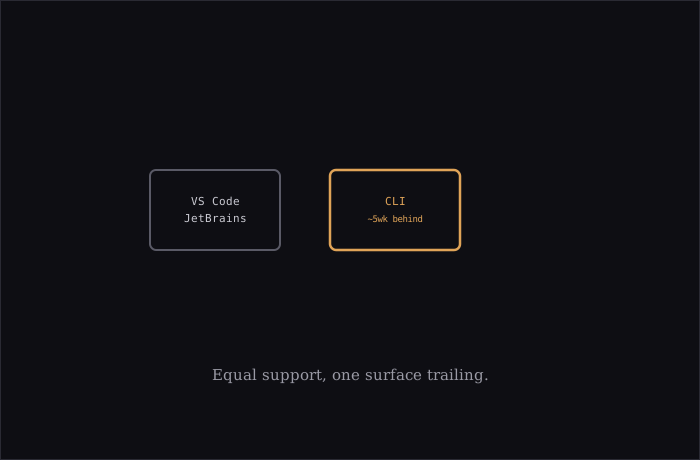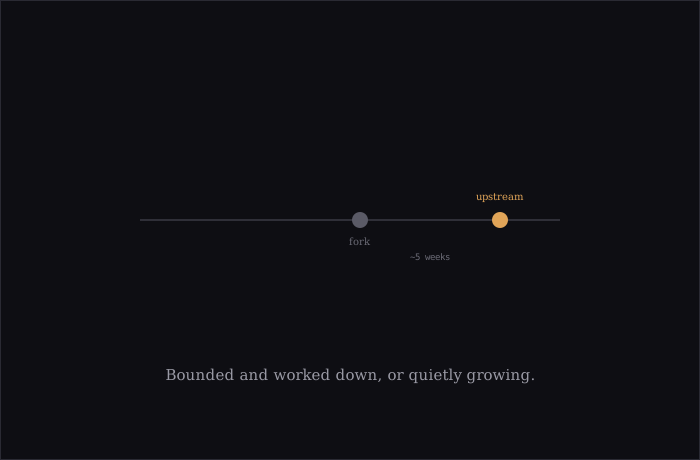
Kilo Code’s CLI runs about five weeks behind the OpenCode project it’s forked from. I’ve written about why this space produces so many forks, but not about what happens structurally once a fork exists and has to keep pace with a moving target — which is really a separate, ongoing cost from the fork event itself.
Why a lag exists at all, rather than a fork just mirroring its upstream instantly: forking isn’t a one-time copy that then magically stays in sync. A fork usually diverges immediately — different branding, different defaults, its own features layered on top, its own bug fixes specific to problems its own users hit. Every time upstream ships something new, the fork’s maintainers have to manually pull those changes in, resolve whatever conflicts arise with the fork’s own modifications, retest that nothing broke in the combination, and then ship it as their own release. That’s real, recurring work, not a one-time cost paid at the moment of forking — and if the fork’s own maintainer team is smaller than upstream’s, or has other priorities competing for the same time, the gap between “upstream shipped it” and “the fork shipped it” grows accordingly.
What actually gets delayed during that gap, concretely: not just shiny new features. Security fixes, bug patches, compatibility updates for new model releases — anything upstream ships lands for the fork’s users only after that same pull-resolve-retest cycle completes. A five-week gap on a routine feature is a minor inconvenience. A five-week gap on a fix for exactly the kind of sandbox-escape vulnerability I’ve covered repeatedly this month is a genuinely different kind of risk, because during that window the fork’s users are running code with a known, already-patched-elsewhere vulnerability, without necessarily knowing that a fix already exists one repository over.
Why a lag isn’t automatically a red flag, though: the alternative to lag is either an abandoned fork that stops tracking upstream entirely — a much worse outcome — or a fork so aggressive about staying current that it never has room to build or maintain its own actual differentiating features, which defeats the point of forking in the first place. A consistent, bounded lag with active changelog activity, which is what Kilo Code’s fork currently shows, is a sign of a fork genuinely doing the ongoing work of staying in sync — just not instantly. The warning sign isn’t lag existing; it’s lag that’s silently growing over time, or a changelog that’s gone quiet, both of which suggest the fork has stopped actually doing that reconciliation work rather than just doing it on a delay.
The practical question worth asking about any fork you’re relying on: not “is there a lag” — there almost always is — but “is the lag bounded and does the changelog show it’s actively being worked down,” and specifically, “does anything time-sensitive, like a security patch, get fast-tracked ahead of the normal release cycle, or does it wait in the same queue as everything else.” A fork that treats a security fix as urgent enough to jump the line is managing the lag responsibly. One that doesn’t is quietly asking its users to accept upstream’s fix timeline plus whatever its own backlog happens to be that month.