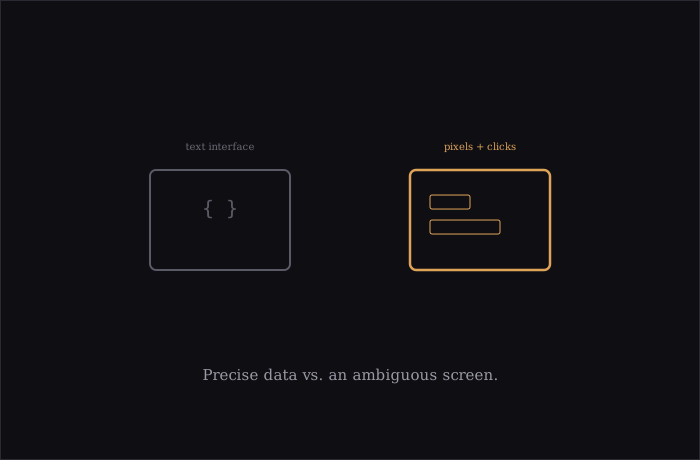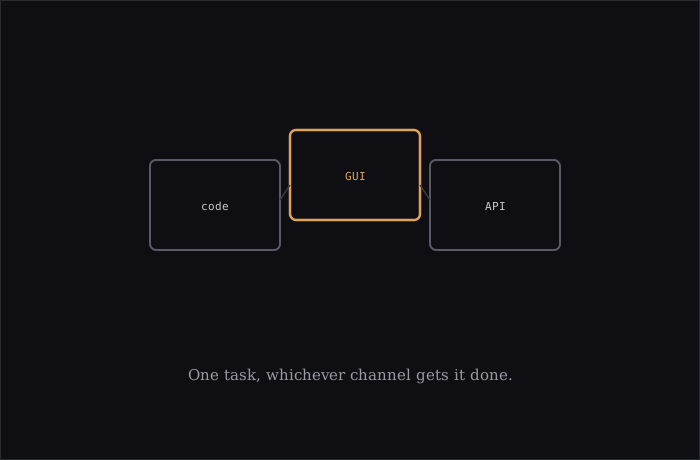
Nearly everything on this site so far has been a variation on the same shape: an agent that reads a codebase, edits files, runs commands. Cua is building for a related but genuinely different category the project calls “computer-use 2.0” — an agent that moves between code, APIs, and actual graphical interfaces within one task, the same way a person might write a script, then switch over to click through a settings dialog, then check a result in a spreadsheet, all to finish one piece of work.
The project, MIT licensed, is really a toolkit rather than one single agent — it deliberately doesn’t ship its own model or agent loop. You bring the agent and the model; Cua provides the computer underneath it and the tools to operate it:
- Cua Fleets — provisions isolated cloud desktops on demand, Linux included, that an agent can run commands against and screenshot
- Cua Driver — executes actions with explicit boundaries around what’s allowed, rather than giving an agent unrestricted control the moment it’s connected
- Lume — spins up local macOS VMs you can connect to over SSH, for testing against a real Mac environment without needing physical hardware
- Cua Bench — a benchmark harness for building computer-use tasks, evaluating an agent against them, and exporting the resulting trajectories as training data — genuinely useful on its own even if you never touch the rest of the toolkit
The most specific new piece is CUA-S1, a family of small, specialized models aimed at exactly the kind of fast, low-stakes decision a full reasoning model is overkill for — which value belongs in a form field, whether to leave an interface element alone. The project’s own framing borrows the “System 1” term from dual-process theory in psychology: quick, bounded pattern-matching, distinct from the slower deliberate planning a general-purpose agent still handles. It’s an explicit division of labor — a big model decides what needs to happen, a small specialized one handles the fiddly UI-level execution of actually doing it, rather than paying frontier-model reasoning costs for every field on a form.
Worth being honest about where this sits today: it’s an early, source-only research release, with model weights hosted separately rather than bundled in, and the whole “System 1” framing is explicitly presented as an engineering analogy the project is still exploring, not a settled architecture. This isn’t a finished product to point at a task today so much as infrastructure for people actively building and evaluating computer-use agents right now.
What I keep noticing across projects like this one: the interesting work increasingly isn’t “make one bigger model smarter,” it’s building the scaffolding — sandboxed environments, benchmarks, driver layers with real action boundaries — that any model can be plugged into safely. The same instinct behind DeepSeek Harness and Pi’s minimal core, pointed at a broader target than a single codebase this time: the whole desktop, not just the terminal.