Small confession: I searched “OpenCode” and spent a good ten minutes reading about the wrong project before I realized it. There’s an archived Go-based one (opencode-ai/opencode) that died in September 2025. The one everyone’s actually talking about is anomalyco/opencode, TypeScript, built by the SST framework team. Worth knowing before you go digging yourself.
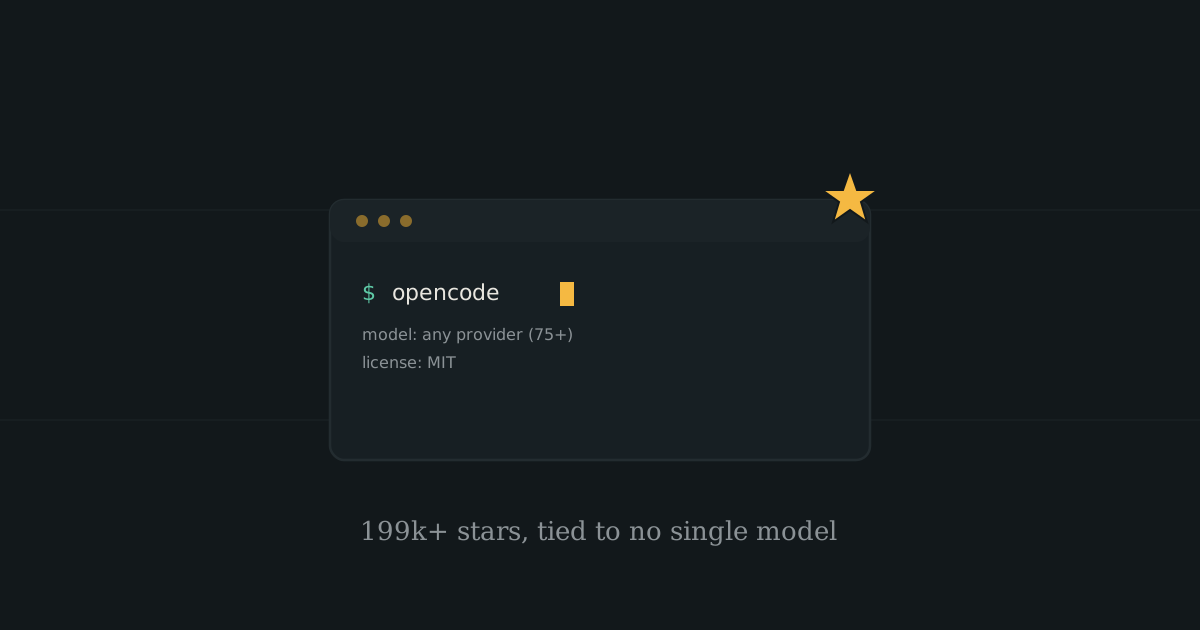
199k+ stars. MIT license. 900+ contributors. That’s more open-source stars than Gemini CLI, Codex CLI, Cline, Goose, or Aider. Claude Code technically has more (142k+), but that repo is just issues and docs — the actual tool is closed source, so it’s not really the same comparison.
The whole pitch is refusing to pick a favorite model. 75+ providers supported, local models through Ollama and LM Studio included, and it runs as a terminal app, a desktop app, or a VS Code extension — client and server are split apart so none of those feel bolted on as an afterthought. That client-server split is worth dwelling on for a second, because it’s the actual engineering decision underneath the marketing claim: the server holds the session state and talks to whichever model provider you’ve configured, and any of the three interfaces can attach to it, so switching how you use the tool doesn’t mean starting a new session from scratch.
The latest release (v1.18.26, September 1) is pretty unglamorous if I’m honest — mostly bug fixes. Claude 5 sessions handling stale thinking blocks better, a Bedrock reasoning-effort setting, tool-call timing staying accurate mid-run. Not the kind of thing that makes headlines. But it’s a decent snapshot of what “actively maintained” looks like week to week, which matters more than any single flashy release, especially set against how many projects in this space have gone quiet without warning.
Here’s the part I actually found interesting though. Back in January 2026, Anthropic blocked third-party tools from using consumer Claude subscriptions through unofficial channels — OpenCode had been riding on that access. Instead of just losing Claude support, they added other subscription options and built their own gateway to keep multi-provider support working.
I don’t think Anthropic was specifically targeting OpenCode there, it reads more like closing a door that was never meant to be open. But it’s a clean real-world example of why “model-agnostic” is an actual engineering decision and not just a marketing line on a README. A tool wired to one provider’s undocumented backdoor has nowhere to go when that backdoor closes. A tool built to swap providers just… swaps, which is more or less the exact lesson Gemini CLI’s users learned the hard way a few months later, minus the part where OpenCode had already built the escape hatch before it needed one.
curl -fsSL https://opencode.ai/install | bash
Releases: github.com/anomalyco/opencode/releases