Meta shipped its first dedicated coding agent back in early August, and it’s worth a proper look now that the initial launch coverage has settled: Muse Code, a terminal-native agent running on a new model called Muse Spark 1.2, built specifically for long-horizon software engineering rather than quick completions.
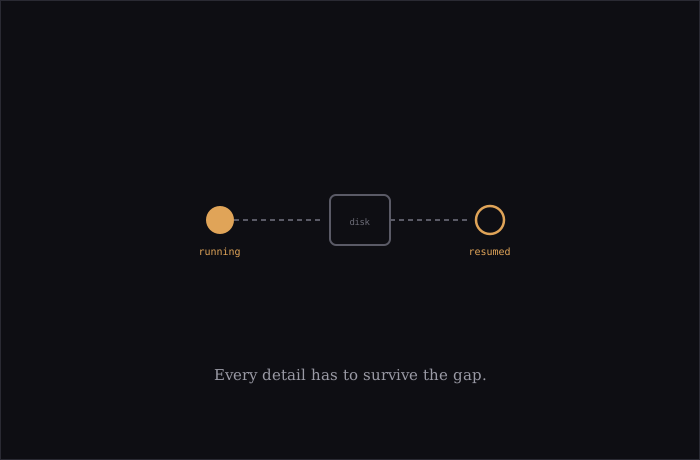
The architecture leans on persistence rather than a bigger context window as its main trick. Instead of a fresh session starting from zero on every task, Muse Code runs specialized background agents that stay active for a whole session, accumulating context about decisions made and files already inspected as they go. For work big enough to split up, it fans out into separate sub-agents running in parallel, each working inside its own isolated git worktree — the same underlying mechanism I’ve covered elsewhere for exactly this kind of parallel-agent isolation — while your actual working copy stays untouched throughout. Every model call, tool run, approval, and edit gets appended to a local event log, which Meta describes as replay-exact and restart-safe: after a crash, the agent picks back up precisely where it left off, close in spirit to the checkpointing approach I wrote about with Google’s AX, just implemented as an append-only log rather than a snapshot-and-resume model.
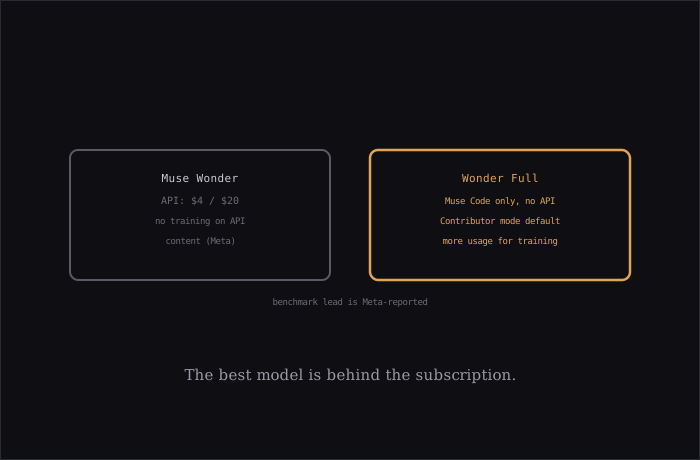
The model itself is a real departure from what Meta had been doing. Muse Spark 1.2 is closed-weight, hosted in Meta’s cloud — a genuine reversal from the open-weight approach the company built its reputation on with Llama. Meta co-trained the model alongside the agent itself rather than adapting a general-purpose chat model, which the company says shows up specifically in complex debugging and whole-codebase comprehension rather than just raw code generation.
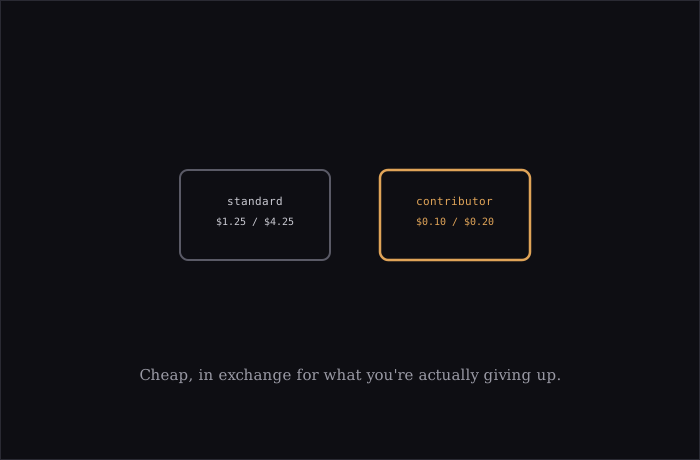
The pricing structure is the part that actually deserves scrutiny, not just a mention. Standard tier runs $1.25 per million input tokens and $4.25 per million output — ordinary, roughly market-rate pricing for a capable coding model. A separate “contributor” tier runs $0.10 and $0.20, a roughly 90% discount, with one condition: you’re letting Meta train on your code. That’s the same basic exchange underlying most of Meta’s other consumer products — a real product made available at a steep discount in exchange for data — applied here to what’s actually being generated inside a developer’s own working sessions: the reasoning, the failed attempts, and the corrections that produced a working commit, not just the finished code a scraped public repo would show. Whether that trade is worth it depends entirely on what’s in the repository you’d be pointing it at, and it’s worth reading exactly what “training use” covers in Meta’s terms before opting into the cheaper tier on anything you wouldn’t want reflected in a future model.
Where it actually lands competitively: Meta’s own benchmark comparisons place Muse Code behind Claude Code and Codex CLI on the metrics it publishes itself, and independent early feedback has largely focused on Muse Spark 1.2 as accessed through third-party harnesses like OpenCode rather than on Muse Code the terminal product specifically — worth knowing if the model’s underlying capability is what draws you in, since you may not need Meta’s own wrapper to get it. Signup friction has also been a recurring complaint, with an identity-verification step and sign-in tied to Facebook or Instagram accounts landing awkwardly for a developer-tool audience that’s largely used to a much lighter onboarding flow elsewhere in this category.
The honest read: a capable, well-engineered entrant with a genuinely interesting persistence architecture, arriving into a category two other labs have been building out for over a year — and a pricing model that, more than anything else about the launch, makes explicit exactly what’s actually being traded when a coding agent is priced far below cost.