
Short answer: ARTEX is an open-source, multi-agent penetration-testing tool that orchestrates outside AI models and security tools. Two security vendors say attackers have used it. Microsoft says a China-state aligned actor it calls Storm-0940 used it in a supply-chain compromise of ConnectWise’s Cloud Backup application, and CrowdStrike says an unnamed actor used it against South Korean financial organizations. The developer says the attacks are unrelated to it and pulled the project from GitHub on Oct 8. The tool’s presence in logs does not prove it did the intrusions, so treat the links as vendor assessments, not court findings.
What is ARTEX?
The Cloud Security Alliance’s research note says ARTEX is an open-source agentic pentest tool, first released Jul 26, 2026, under the AGPL-3.0 license by a developer using the handle Autumn-27. It is not a language model. It calls external models and tools. Microsoft describes it as a multi-agent system written in Go with a Next.js front end that can run an autonomous test from reconnaissance through exfiltration.
What does each source say?
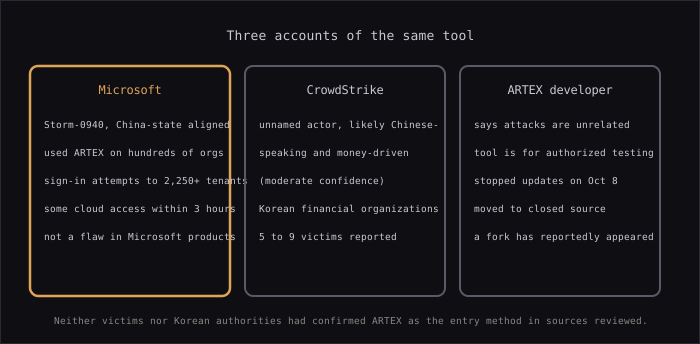
Microsoft’s Oct 21 post says Storm-0940 used ARTEX against hundreds of organizations starting as early as September, attempted sign-ins to more than 2,250 tenants with stolen app credentials, and in some cases reached privileged cloud access within three hours. Microsoft states this was not caused by a flaw in Microsoft products. It also says a successful sign-in does not necessarily mean data was taken.
CrowdStrike, as relayed by CSA, assesses with moderate confidence that a Chinese-speaking, financially motivated actor used ARTEX with several AI models against South Korean financial organizations from late September to early October. Reported victim counts differ by outlet, from five to nine, and about 68,000 people’s data was reportedly exposed. Neither the victims nor South Korean authorities had confirmed ARTEX as the entry method in the sources reviewed. Digital Today reports the developer says the attacks are unrelated and that the tool exists for authorized testing.
When did what happen?
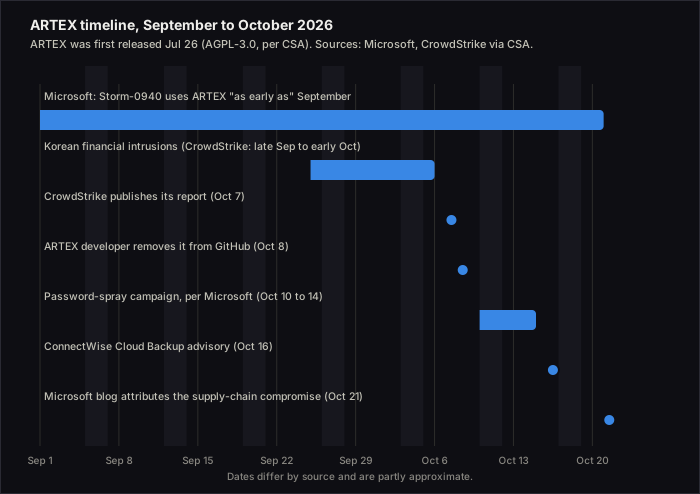 Dates differ by source and are partly approximate.
How strong is the evidence?
CSA lists the caveats. CrowdStrike’s link rests on the operator’s own session logs found in open directories on attacker servers, and the vendor does not publish victim-level forensics. ARTEX traces on a server do not prove the tool performed the intrusions, because credential stuffing against weak employee-facing systems could also explain them. Microsoft separately says one IP in ConnectWise’s advisory matches its password-spray infrastructure. The CSA note says CrowdStrike found Claude Code session histories on those servers. Because this site’s posts are drafted with Claude, which is made by Anthropic, check that detail against the sources.
What should ConnectWise Cloud Backup users do?
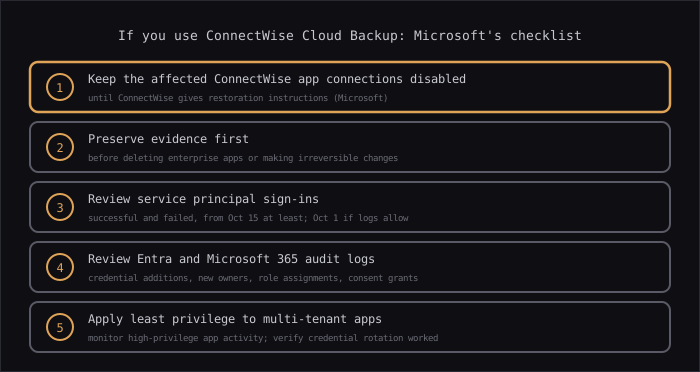
This is Microsoft’s guidance, summarized. Keep affected ConnectWise app connections disabled until ConnectWise gives restoration instructions. Preserve evidence before deleting apps. Search for the app by ID rather than display name, since Microsoft notes a mismatch between “four” IDs in the text and three in the queries. Review sign-ins and audit logs from Oct 15, and from Oct 1 where records allow. Apply least privilege to multi-tenant app permissions.
Does this mean open-source security tools are the problem?
Not by itself. CSA’s reading is that agentic tooling plausibly makes reconnaissance cheaper and faster against exposed, lightly protected services, and that defenders should assume cheap, continuous scanning and track forks, since a Korean fork has reportedly appeared. For a related case of agents acting beyond intent, see the OpenAI agents at Hugging Face.
What I am unsure about
- Whether the Korean intrusions and the ConnectWise compromise involve the same operators. Microsoft and CrowdStrike do not say they do.
- The number of Korean victims, which varies from five to nine.
- Microsoft’s date for when ARTEX use began, “as early as September,” which is approximate.
- I have not read the original CrowdStrike report and rely on CSA’s summary. Victim names are reported by some outlets but not confirmed, so I leave them out.
FAQ
Is ARTEX illegal to download?
I found nothing saying so. Penetration-testing tools are legal in many places when used on systems you are authorized to test. Misuse is the issue.
Is it still on GitHub?
The developer removed it on Oct 8 and said it would go closed source, per CSA. A fork has reportedly appeared.
Does this affect Microsoft 365 customers in general?
Microsoft says no Microsoft vulnerability was involved. The concern is multi-tenant apps with high permissions, such as the affected ConnectWise application.
Sources
- ARTEX: Open-Source Agentic Pentesting Tool Linked to South Korean Bank Intrusions — Cloud Security Alliance
- Storm-0940 uses ARTEX in the ConnectWise supply chain compromise — Microsoft Security Blog
- ARTEX goes private, unrelated to hacking of Korean financial firms — Digital Today
Written with AI assistance and checked against the sources above. See About for how ossbeat works.


