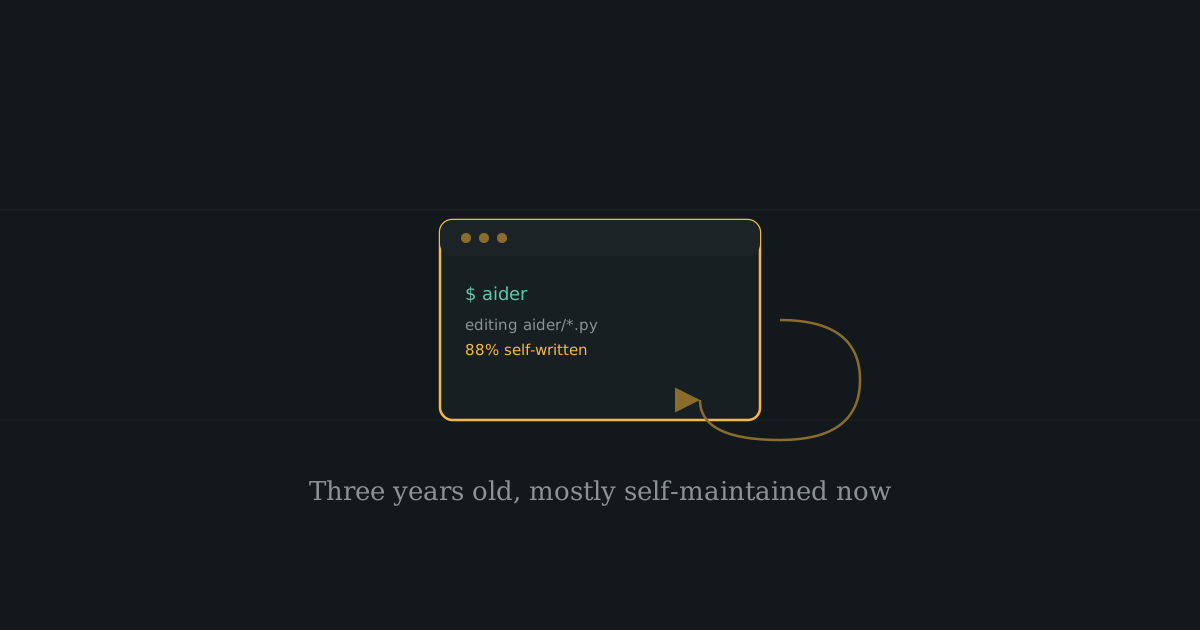
I hadn’t covered Aider yet, which is a little embarrassing given it’s been around since 2023 and sits at 44,000+ stars with something like 6.8 million PyPI installs. Apache 2.0 licensed, built by Paul Gauthier, and — unlike most of what I write about — genuinely old by this space’s standards. Three years is a long time for a project to still be actively used rather than replaced by whatever shipped last month.
It’s terminal-first: point it at a git repo, describe what you want changed, and it edits files directly, then auto-commits with a generated message. No IDE plugin, no GUI — it sits next to whatever editor you already use rather than replacing it. It builds a map of your whole repository using tree-sitter parsing so it has structural context without needing every file loaded in, and there’s an “architect mode” that pairs a planning model with a cheaper one for the actual edits, which is a neat way to cut costs on big sessions.
The stat that actually stopped me: as of a recent release, reportedly 88% of the code in Aider’s own codebase was written by Aider itself. Not “AI-assisted” in the vague sense every tool claims now — the maintainer apparently tracks this directly. A three-year-old open-source project where the tool has become the primary author of its own source.
A couple of practical notes if you’re considering it, since it’s not without rough edges:
- Still in 0.x versioning as of this year, and breaking changes to CLI flags or the config file format have happened across minor releases — not something to pin blindly in CI
- Auto-commit creates one commit per AI edit, which is great for auditability but makes for noisy history in a squash-merge workflow; there’s a
--no-auto-commitsflag if that bothers you - No SOC 2 or enterprise compliance paperwork, so if that’s a requirement at your job, this probably isn’t getting approved
I haven’t run it long enough myself to have an opinion on how the self-written-code claim holds up under scrutiny — that’s the kind of stat that’s easy to state and harder to verify from the outside. But even taken as a rough approximation, a tool old enough to have real staying power in this space, now largely maintaining itself, feels like a genuinely different kind of milestone than another launch-week release.
pip install aider-install
aider-install